« February 2006 | Main | April 2006 »

March 31, 2006

Heads Up For Silver


According to a reliable source, AMEX Chairman & CEO Neal Wolkoff told Bloomberg this morning that the exchange may begin offering Barclay Capital's silver ETF as soon as next week, though Barclay's petition is still pending…

This should be regarded a rumor until a formal pronouncement.

But, undoubtedly the anticipation of this fund has contributed to silver's spectacular 98 cent spike this week.

The front month COMEX contract popped above US$11 yesterday and is currently trading at about US$11.66 / oz.

Since the November '05 breakout from a 20 month triangular formation on a price chart, silver is up by almost US$4 per ounce, or a little more than 50 percent. As we had noted previously, the implied objective of this particular formation measures to about US$12; it could be extended to US$13 if we abandon some conservatism. So what's next?

My target remains at US$12 plus or minus, probably plus (US$12.66 seems to stand out in my mind).

But I would look for the onset of a correction not long after the ETF is approved for the simple reason that speculators are likely to sell the news that they've been anticipating for over a year. Yet the market may find good support above the US$10 level from two sources - ongoing gains in gold and the demand for silver that Barclays actually generates.

Speculators can be right on occasion, after all.

Vigilance is warranted, still, because there's always the risk that either the regulators balk at the petition in the last inning, or that the issuer (Barclays in this case) balks due to changes in the price of silver since initiating the ETF.

In my view there is more value in gold than silver at least up until the day that the market's focus is on inflation and money, or in the shorter term, up until the day that the stock market rolls over or a geopolitical event occurs.

The silver play that is a byproduct of this ETF news is a diversion that makes gold just that much more alluring.

Precious metals bulls' answer to this week's FOMC statement was particularly encouraging. After booking some profits, they pushed gold to a new 25 year high the very next day in an exciting feat of strength. In other words, the market brushed off the Fed's hawkish overtones faster than usual. The initial breakout point was the move through the last lowest high in the Feb-March downtrend (US$572), which occurred last night; but the new and higher high today was the decisive factor. Platinum is the only metal that has yet to confirm the metals run, but it is within an earshot.

I am cautious about Monday because April 1st makes me nervous (i.e. it's my father's birthday for one - which makes me the son of a joke!). Also, aside from the TSE index, it would be good to see the other gold stock averages confirm the breakout. The six week correction in the averages occurred mainly in the larger cap gold shares, as expected, while the silver and small cap names continued on to new highs. It is noteworthy that the corrections in most of the gold shares occurred within the context of what technical analysts refer to as bullish flags (a normal sequence of lower lows accompanied by dwindling volume), and that as of this week they are all breaking out of their flags. Of the pool of gold producers that the market considers purely gold plays, only Glamis, IAMgold and Meridian have confirmed the breakout in gold with new highs so far - all which consist in our index - but it would be nice to see confirmations from names like Anglo, Bema, Eldorado, Freeport, Gold Fields and Newmont (Goldcorp holds significant silver & copper exposure now).

If we get past Monday I think we will. The market really looks poised to finish this sequence. And in spite of my US$633 gold target, I have a feeling this rally is going to continue at this pace until we start asking, how high can it go?

It should be making central bankers and bond-holders nervous that the FOMC threat fell upon deaf ears!

INVESTMENT RECOMMENDATIONS


 Donald G. M. Coxe
Global Portfolio Strategist, BMO Financial Group

1. Global stock markets are pricing in nothing but good times.
Nevertheless, with the Fed, the ECB and the BOJ in tightening modes of
varying intensity, the global liquidity flood that has been lifting most
boats has crested. Adding heavily to equity positions at a time of rising
geopolitical tensions and shrinking liquidity is an unsound strategy. Use
strong rallies, particularly in US stocks, to reduce equity exposures.
2. Remain overweight in oil and gas stocks, with heavy emphasis on
Alberta oil sands companies. US refiners remain very cheap, and
Washington's lawmakers, who speak with forked tongues,
simultaneously command the oil companies to change their gasoline
mixes (at great cost), and control their price increases. We believe they
will achieve the first objective, but fail miserably in the second.
3. Remain overweight the base metal producers. Every base metal except
nickel hit alltime highs in recent weeks, but their stock prices did not.
They remain the most attractive commodity producing group (other
than the Alberta oil sands producers).
4. Remain overweight the gold and silver producers. The speculation
attendant on creation of the silver ETF has made the byproduct silver in
the typical gold deposit more profitable. Emphasize those mines with
the best reserve characteristics.
5. Ben Bernanke says the flat yield curve isn't a significant indicator that
the economy will slow down. If so, then "It's different this time" has
become the cornerstone of Fed policy. He could be right, but if you have
substantial US equity exposure, then your bond portfolio should be
betting he's wrong. Increase your US bond durations and upgrade your
portfolio quality in balanced portfolios. In bond-only portfolios, be
alert for more signs that the economy will be softening by summer, and
prepare to move from neutral to long duration.
6. The dollar is getting help from those rioters in France, and from the
market's belief that Bernanke is committed to raising rates to 5% and,
perhaps, beyond. The French rioters will go away well before Bernanke
stops tightening. By late this year, both those dollar props will be gone.
March

March 30, 2006

Prestowitz Urges Koizumi To Call for "Plaza Accord II" at G8

 
To Call for 'Plaza Accord II' at G-8

From Kyodo News Agency
Tuesday, March 28, 2006

http://asia.news.yahoo.com/060328/kyodo/d8gki7284.html

Japanese Prime Minister Junichiro Koizumi should take the lead at a
Group of Eight meeting in calling for a "Plaza Accord II," former
U.S. trade negotiator Clyde Prestowitz said Tuesday.

"We all need to cooperate on diminishing the role of the dollar in
international trade," said Prestowitz, now the president of the
Economic Strategy Institute, which he founded, at a lecture at the
Foreign Correspondents' Club of Japan.

Even though Koizumi is going to step down from the premiership in
September, he is in a good position to suggest that G-8 leaders
adopt a new Plaza Accord to help reduce current global economic
imbalances similar to those seen in the mid-1980s, when the first
accord was struck, Prestowitz said.

The 1985 Plaza Accord was signed by the then Group of Five economic
powers to coordinate foreign exchange policies. Troubled by a large
trade deficit, particularly with Japan, the United States under the
administration of President Ronald Reagan aimed to bring down the
value of the U.S. dollar against other major currencies.

Since then the world economy has gone through a radical
transformation, with China and India emerging as major economic
powerhouses. The G-5 has now expanded to the G-8 grouping Britain,
Canada, France, Germany, Italy, Japan, the United States and Russia.

But the U.S. dollar is again in a situation in which many
economists, including Prestowitz, see it as overvalued and partly
responsible for increasing trade deficits in the United States.

The U.S. government recently said its current account deficit in
2005 totaled $804.95 billion, up 20.5 percent from the previous
year, to hit a record high for the fourth straight year due to a
bigger goods trade deficit on higher imports and oil prices.

"We are back (to a similar situation to the mid-1980s with a similar
global economic imbalance), except it's bigger and there are more
players," said Prestowitz, a trade negotiator in the Reagan
administration.

To help resolve this matter, he said the United States should raise
taxes and increase financial savings, while other countries should
stimulate consumption.

As a means of solving the problem, the world needs to begin pricing
oil "not in the dollar but in a basket of currencies," such as the
yen, dollar, euro, and yuan, he suggested.

THE FIBONACCI FORECASTER

He is worth reading, but I'm putting this up a day late, sorry! 
Edited By Jeff Greenblatt
March 28, 2006
Greetings:
It was the first week of January 2001, specifically THE SECOND TRADING DAY OF THE YEAR when I had my first REAL FED EXPERIENCE because there was real cash on the line that day.  I was short a basket of internet stocks (who wasn't) that day.  Memory fails me if that was the FIRST rate slashing of the cycle but it certainly was the first rate slashing that came at the discretion of Mr. Greenspan to act between regularly scheduled FED meetings.  That much I remember.  With no warning they lowered interest rates that day and all of my internet stocks went parabolic through the roof.  My boss, who was still vacationing in Italy, called fearing the worst which I confirmed.  I had been in Las Vegas that weekend celebrating the new millennium.  I think I should have stayed an extra couple of days.....
I survived that experience and slowly over time Fed days improved over time for me.  What I've learned and you probably have as well is that FOMC meetings are market events to be strategically planned for, must be dealt with carefully and are each unique events where no two are exactly alike. One thing you can take from is it doesn't matter what they do, but they usually don't give the market what it wants.  If you can understand the hype and hysteria that starts leading up to one of these events 3-4 days prior you'll do well.  Understand the universal mind that is the mass crowd psychology behaves like a spoiled brat and if you understand the game that the FED is likely to scold the child or in the very least not give the child what it wants you can realize these Fed events become fairly predictable.   I've read or listened to the talking heads mention there would likely be a hike but it should be the last one.  People come to expect that and when they raise rates and announce on top of it they reserve the right to DO IT AGAIN, people get upset and the market sells off.
One never really knows what to expect because the charts over the past few years have reacted like the Richter scale but today those who were following the intraday commentary saw we did a fairly decent job of navigating through it. To be fair, this was one of the tougher patterns leading up to the zero hour but we did not get sucked in by that spike this morning because it seemed to be TOO EARLY to be taking off.  Also, for the past four sessions, I've been using the SOX as the guiding light and as the markets were lifting off this morning, the SOX was still lagging. 
It turned out to be one of my best FED experiences ever.  Thank you Mr. Bernanke and welcome!
THIS AND THAT
There were several of you who wanted to know why I like Jeffrey Kennedy.  Keep in mind that Prechter/Hochberg have that GSC bear market agenda but they have excellent analysts in their employment.  You can spot holes in just about any analyst's game (Kennedy and myself included) but Kennedy happens to lay out a running triangle as well as anyone I've seen.  If you can lay out a running triangle correctly, you can increase the percentage of time you will know which way a triangle will break.
Finally, my web designer tells me the new website should be ready in July.  This is behind schedule but suits me just fine since my own personal situation has in reality set me back at least a month.   For the multitudes of new readers, you get an extended chance to test drive everything here for free until then.  However, my strength is FINALLY coming back and I'm almost at 100% so that means all of the plans to turn this embryo service into a world class product are close to being back on track.
THE STOCK MARKET
Last week the NDX bottomed in an area that did not allow us to rule out a bullish expanded flat pattern.  While we still have not taken out that low we still can't rule that pattern out.  However, the bullish case took a serious hit today.  Last week I devised a credible strategy of wading through the noise and simplifying what we needed to follow in order to stay one step ahead of the game.  Follow the SOX, and it certainly isn't the first time and won't be the last time this strategy takes on added importance.  There are those of you who rely upon Dow Theory to confirm bull and bear cycles but someone ought to do some hypothesis testing on the SOX and NASDAQ/NDX to determine which is the right side of the trade.  In reality, Elliotticians are supposed to follow an important chart that has the clearest wave count.  If you've looked at the Dow or SP500 the past few days you know those were next to impossible to read clearly and perhaps misreading the SP500 count is the only mistake I did make through this FED experience.  Luckily, the SP500 is not the leader of the market from one day to the next.
We had a potential running triangle developing in the SOX and to be sure, I don't know if Jeffrey Kennedy had such a count since he follows the Futures game.   But the situation in the SOX sure looked like one.  We started out higher on  Friday.  The SOX certainly had its chance to break higher but it never did.  As a matter of fact, it never did violate the converging trend lines for that triangle either as it needed to stay under 510 or the pattern would have been negated.   Today the NASDAQ and NDX spiked but the SOX just couldn't get going, that kept me from getting overly excited this morning.  Finally, the SOX broke down as anticipated first to the lower trend line and finally below the prior low at 492.36.  By breaking THAT LOW, any bullish interpretation of that triangle is negated unless the triangle IS MUCH, MUCH LARGER and that I sincerely doubt.  The SOX also closed below a rising trend line that has supported this rally for months and is in danger of a serious drop. 
The NASDAQ came very close to last week's high but once again FAILED AT RESISTANCE.  The Dow and SP500 are also at the upper end of their respective channels and have pulled back.  You certainly have to wonder if THIS is FINALLY the time we get that deeper pullback.  We are certainly setup for it here.  For once, social mood supports this view.  Did you notice the immigration rallies this weekend?  We don't do politics here so I'm not offering up what I think of the immigration policy but I will tell you with 100% certainty the fact they are cracking down on illegal immigration is a CONTRACTIONARY MINDSET.  Think what you will about what Congress may or may not do, but they certainly had no problem with illegal immigration in this country during the bull market years of the 80s or 90s.   Couple that with an angry crowd, (today in Phoenix students walked out of class and while marching on the state Capital building looting was reported) and you have the recipe for social mood rolling over.  Who said nobody walks in LA?  On Saturday a half million people showed up and if any of you have ever lived in LA, you know its hard to get anyone in Tinseltown too excited about ANYTHING.  On Friday there was a demonstration here in Phoenix where thousands showed up bringing traffic to a crawl all over this city.  In 16 years here I've never seen anything come close to that.  Leaving the politics of the situation out, clearly something is going on with social mood and it seems to finally be reflected in the charts.
Whoever is running that Plunge Protection Team, you better start buying tomorrow morning or you'll be asleep at the wheel.   They wouldn't let that happen, would they?
In reality, this might be the first time in a long time that we could pull away from the top.  I'm not stating  the final top is in place, but I think the market gave us a clue here today as it has had several chance to recover like many times in the past year but did not. 
BOTTOM LINE:  The SOX is sitting right below important trend channels in TWO DEGREES OF TREND.  In the very least, if this was a 4th wave (or X wave) triangle we could be close to a low and there is a cluster of support in the 470-475 region.   These are numbers first discussed here two weeks ago.  However you slice it, the NASDAQ failed at resistance today.  The exact nature of the overall pattern is still not clear but if we are still going up, it likely must regroup before it makes another charge at the high again.  The NDX has a shot at the bottom of the range here which would be the February or March low again.  The Dow has a cluster of support at 11100 and the SP500 1260-70.  Before we get there, after 33 bars down on a 5min scale and 11 on the 15 min scale there is a good chance for a bounce tomorrow.  With a p/c over 1.00 we'll see what bulls can do with this. 
AUSTRALIA
The All Ords is down today after hitting a high of 5061.  Counting the reversal day in February your low to high is now 29 (Lucas) days.  What happened yesterday is what we call the NISON DOJI.  Pure dojis are where we close at the exact price point where we opened.  However, Steve Nison says the Japanese tell those of us in the west to chill out.  We are too technical and play it too close to the book.  Yesterday your open was 5045.10 and close was 5044.79.  The Nison doji is defined as a the open and close being within a buck.  You missed by 31 cents. Since you are 29 days up (a common relationship), 160 weeks up, near the top of the trend channel, put up a doji and gapped down today on the open you have a number of elements in place for a reversal.  All you need is some follow through.  I think if we continue down, you have an excellent chance of joining us. 
GOLD, SILVER AND THE XAU
The outlook here was that gold was in a B wave that was near completion.  Last Thursday it finally bottomed on the 54-55th hour of the trend which includes 18 hours up and 36 hours down.  We are now another 19 hours up but also 13 days off the low.  The two legs up are nearly equal as well as one is 24 points and the other 25.  Two legs nearly equal in terms of PRICE AND TIME.  All told we are 221 hours off the TOP back on February 2nd.  We've reached a point like other charts where we are up against a resistance zone which is the area from the March high to the February high (576-85 on the June contract).  This has the look of a larger sideways pattern and this could be the top of B right here.  So what could be going on is we've had a three leg affair down from the top for A, now a smaller 3 legs up for B and if it's going to drop, we would be close before a C wave would take it one more time to the bottom of the range.  Of course, this might not happen, but the chart has to prove it can get through resistance right here.  We are 13 days up but I'd feel much better about this outlook if for instance we were topping at 233 hours instead of 221.  We'll see, we could go sideways for 12 hours and then start a drop on the 233rd hour. 
Silver has no such problem as it continues to make new highs.  Like the All Ords, silver is also up 29 days from a February low and has started to put in a small body candles.  However this looks like another sideways consolidation.
The XAU put in a low with a first leg up and then a 2.61 extension bigger leg. This chart has an interesting relationship where the first leg off the bottom back on March 10 was 29 hours.  This leg from Thursday is 18 hours.  Here is a case of the Lucas series in action.  For those of you who are new, why is this important?  In terms of time 18 and 29 have that 1.61/.62 relationship so important to the Fibonacci sequence.   Recall the outlook here was for a leg to challenge intermediate resistance at 135-41.  We've done that.   Now we have a small gap at 134 we are filling but more importantly have to test if the area around 132 is going to become support by way of the polarity principle.  Overall, we have small degree time sequences that have just expired and will have to see if this next pullback cycle is benign or something more.
US DOLLAR
We had a low a week ago Friday and upon completion of the wave a short pullback. This leg came down to intraday support but more important turned on the 46-47 hour low to low cycle off the bottom.  That is a bullish sign especially since the bars that have followed are nice looking white candles.  We really haven't had much of a retest of the low and maybe by default, we won't.  I'd now look for a retest of recent highs now as opposed to lows.
BONDS
Recall last week we had a slow moving 5 wave sequence over a 7 day period.  The outlook was for a sharp reaction in the other direction.  We achieved that on Friday but all it did was allow us to fail at recent resistance. Today we broke through important support but DID NOT CLOSE BELOW.  If we were to finally break below this support that has held up this market for the better part of 6 months.  This is a floor in the market that has held interest rates from really starting an upward spiral.  Here is another test for you conspiracy theory buffs. Interesting how the stock market and the bond market are both at key places on the chart that could really create a lasting effect on the economic outlook not only for the rest of this year but perhaps for the rest of this presidential cycle.   We are here, right now. 
Today marks the 49th day of the current down leg in this cycle.  Sorry, but Lucas didn't bail us out of this one.  As a matter of fact, the most recent high on March 16th was the 198th trading bar off last year's top.  So this latest downtrend from the March high started on the 199th (Lucas) bar.  We may not hit a low here until the 55th bar of the current leg which is still a week away.
CRUDE OIL
We are sitting at the 61% retracement level of the down leg finally and also 28 days up.  This is another chart at a key crossroad.  Overall this pattern is very choppy so it doesn't look like it has LONG TERM UPWARD POTENTIAL but now it has to decide if it wants to make a run at the high. Due to the choppiness I'm surprised it got this far as I thought incorrectly it had a better chance of going down.  Whatever the case, tomorrow will be the key day.  We are also 139 hours up.  Tomorrow we could top at 29 days and 144 hours.  The market must make a decision.  IF not, it will continue on most likely to the 33-34 day cycle and the 162 hour cycle early next week.
Jeff
For those of who are new, this is the link you follow to get to the charts.  IF you like what you see, please vote for it at the bottom of my page once a day.
The content in THE FIBONACCI FORECASTER is for educational and informational purposes only.  There is no offer or recommendation to buy or sell any security and no information contained here should be interpreted or construed as investment advice. Do you own due diligence as the information is the opinion of Jeff Greenblatt and subject to change without notice.   Please be advised to consult your investment advisor, attorney or tax professional before making any investment decisions.  Jeff Greenblatt will not accept any responsibility or be liable for any investment decisions based on the information discussed here.
You are receiving this email because you requested in writing to be on the email list and  receive The Fibonacci Forecaster.  If  you want to unsubscribe and be removed from this list contact fibonacciman@aol.com

March 29, 2006

Peak Oil Flash

A very important flash presentation on Peak Oil.

Resource Capital Research release Uranium Juniors Report

Resource Capital Research, an equity research company which focuses on small resource companies, today launched a major quarterly research report covering 22 global uranium exploration and development companies with a focus on Australia, Canada and the USA. Over 130 junior and mid cap explorers and development companies are identified with a total market capital exceeding US$7 billion.
The report reviews companies active in established uranium districts globally, including Australia, Canada, USA, Mongolia and Namibia. The report covers North American traded companies Fronteer Development Group (AMEX: FRG) and (TSX: FRG), CanAlaska Ventures (TSX-V: CVV) and (OTC BB: CVVLF), International Ranger Corp (OTC: IRNG) and Western Prospector Group (TSX-V: WNP). A feature article reviews surficial calcrete style projects which are driving valuations for a number of companies, namely, Paladin (PDN, development project, Namibia), Nova Energy (NEL, scoping study, WA), Redport (RPT, advanced exploration, WA), Uranex (UNX, advanced exploration, WA), and Extract Resources (EXT Namibia, early exploration).

To access the free summary report, go to http://www.rcresearch.com.au/feature

Wither Iron Ore Prices

It all used to be so easy. The ore-mining companies, based in the major producing countries of Brazil and Australia, would sit down once a year with their main customers, the big steelmakers of Japan and Europe, to negotiate annual contract prices. The price of iron ore remained relatively stable throughout the 1990s.

What upset this comfortable status quo was the spectacular growth of Chinese steelmaking, with its ravenous demand for imported iron ore. In turn, the pressure placed on Chinese steelmakers - which already suffer from low profits - by rising iron-ore prices has changed the structure of the price negotiations: in the current round of talks to determine annual contract prices, which will run from next month, China demanded and received a place at the negotiating table. And China is making sure its voice is heard loud and clear.

So what's the background to all of this? Simply that over the past few years, China's increasing hunger for steel has led to an unparalleled growth in domestic steelmaking - 15 years ago China made 10% of the world's steel (80 million tonnes), while this year it will make an unprecedented 33% (about 400 million tonnes). And to make that steel requires more and more iron ore, some of it mined domestically, but with a growing proportion having to be imported, principally from Australia, Brazil and, increasingly,  India. Demand by Chinese steelmakers for imported iron ore has quadrupled from 70 million tonnes in 2000 to 275 million tonnes last year.

It should perhaps be mentioned that not all steelmakers are beholden to the producers of iron ore. For example, electric-arc furnaces (EAFs, or mini-mills), which produce about one-third of the world's steel, use a feed of ferrous scrap and hence, for the most part, are not overly dependent on iron ore (although such scrap substitutes as directly reduced iron and pig iron are in fact ore-based). It is the integrated steelworks, using basic oxygen furnaces (BOFs), which produce about two-thirds of the world's steel, that depend on iron ore to feed the blast furnaces, which make the molten iron, which in turn feeds the BOF steelmaking plant.

Why the Chinese rush for iron ore? The Chinese steel industry, because of indigenous coal and iron-ore deposits, is predominantly based on the iron-ore-hungry BOF steelmaking route, which produces some 85% of China's output. A further complicating factor is that China's steelmakers also use domestically produced ore. The numbers for 2006 break down as follows: China's blast furnaces will probably produce 360 million tonnes in 2006, an increase of 30 million over 2005, which will require an additional 48 million tonnes of iron ore.

China's use of domestic ore is expected to be 528 million tonnes, which, it so happens, also represents a 48-million-tonne increase over last year, but - a big but - because local ore has a low ferrous (iron) content, this translates to only 23 million tonnes of concentrate. That leaves an ore shortfall of 25 million tonnes or so, all of which will have to be imported. So last year's record imports of 275 million tonnes of iron ore could well hit the 300-million-tonne mark in 2006.

Another wild card is that transporting iron ore is no trivial task: the material's bulk means that amounts tied up in transit at any moment are significant, and there could be a further 30 million tonnes of iron ore tied up in Chinese seaports at the moment.

That gets the numbers out of the way. What about the politics? First, we need to identify the key players whose actions will determine how the iron-ore crisis - if one can call it that - plays out. There are three: the ore miners, the steelmakers (writ large), and the Chinese.

There are just three major ore suppliers: Companhia Vale do Rio Doce (CVRD) of Brazil, and the two Anglo-Australian giants Rio Tinto and BHP Billiton. Together, the three control about 70% of seaborne iron ore. So how do the mines see things?

First and foremost, they would argue that prices must be determined by the rules of supply and demand - market forces - and at the moment, demand is strong, with spot prices currently higher than contract prices. Second, to meet the meteoric rise in ore demand, huge investment programs have been launched, and the miners argue that the levels of investment needed to meet existing and future demand can only be supported by realistic price structures. CVRD alone is investing about US$4.6 billion this year in mining and transport projects. Simply stated, if more ore is needed, then more investment is needed, and that inevitably affects the end-user prices.

Unsurprisingly, the steel industry takes a different view. There is a feeling that the unprecedented 71.5% increase in the contract price last April was more than adequate and should be held for at least another year. Steel prices had to rise in 2004 on the back of higher raw-material costs, but fell back again in 2005 as steel demand weakened. For steelmakers to pass on higher steel prices, caused by the ore-price increases, to customers this year could be trickier - especially since EAF-produced steel, which competes directly with BOF steel for many product types, has not seen any significant increase in costs for its input material, ferrous scrap.

Among steelmakers, who themselves are beginning to consolidate into bigger and stronger groups, there is also a growing desire not to be held to ransom, so to speak, by three giant ore producers. So 2006 is seeing a new new stubbornness in the air - which brings us back to Chinese steelmakers.

This year, there is a new voice in the negotiations, with Chinese steelmakers, represented by Baosteel, entering the discussions for the first time. China's greater role is directly attributable to the country's overtaking Japan as the world's largest importer of iron ore.

This year, China is expected to import a massive 43% of the world's sea-borne iron ore, probably 300 million tonnes out of a world total of 700 million tonnes. And China, having ousted Japan as the key negotiator, is feeling its way in using its huge buying power to force a settlement they deem fair. (For Japan's part, it is probably letting the Chinese take the lead in order to insist on the suppliers equaling for Japanese customers any price relief that China is able to negotiate.)

The appointment of Baosteel to negotiate for China was highly significant, especially since it was accompanied by a government ban on negotiations by all other Chinese steel companies. In effect, the action undercuts market forces by forming the Chinese industry into a single cartel for the purpose of ore negotiations.

From China's point of view, the clear rationale is to put greater pressure on the miners by combining the buying power of China's steelmakers. There is no question that the stakes are high for the Chinese steel sector: Morgan Stanley chief Asia economist Andy Xie noted on March 16 that "for many steel mills in China, the ore price amount could mean the difference between life and death in 2006 ... China may have to play hardball to stop the ore producers [from] bankrupting China's steel industry."

But are the hardball tactics working? Based on reports of the negotiations so far, it appears that both sides have had to compromise. In late February, it was reported that initial negotiations between Baosteel and the miners had broken down, for exactly the reason one would expect: price. China argued that the ore producers should act with restraint, in view of the fact that some 40% of China's 80-odd large and medium-sized steelmakers reported financial losses in 2005. Chinese industry officials have also fretted publicly over the possibility of oversupply in the global iron-ore market, as the big investments of the past two years come on line.

But such arguments cut little ice with the miners, who understand well that production declines in the Chinese steel industry, in the event negotiations failed and supply deliveries were halted, would be catastrophic for the Chinese economy. However, this is very unlikely in any case, since the custom in the industry is for the previous year's prices to be maintained if negotiations drag on beyond the usual time frame. So the ore miners have little to lose by standing fast: at worst, they will continue to be paid the same record prices they were paid last year.

As of late this month, China was continuing to hold out for price relief, with the National Development and Reform Commission (NDRC), China's top economic planning body, saying on March 15 that Chinese steelmakers would not accept higher prices, calling the miners' profits "huge and unreasonable", and pledging to fight "unacceptable" demands in order to protect the country's steel industry. "China cannot afford a further rise in prices," the NDRC report stated flatly.

The action might be having some effect: a March 27 Bloomberg report cited Australian analysts as saying that the miners might have to accept a 10% increase this year as opposed to the 20% they had originally wanted, and noted that the "big three" miners have all seen declines in their share prices because of the dispute.

The question now is whether the issue of 2006 iron-ore contract prices has gone beyond the level of companies and has become a diplomatic issue, after the revelation that the Chinese government warned the country's steelmakers that ore imports may be blocked if prices are too high.

This raises the possibility that Chinese caps on imported iron ore could be ahead; would Australia or Brazil retaliate if that step was taken? (The Australian government has already said it would be "alarmed" to see Chinese government intervention.) And what would the implications of a trade war over iron ore be for China's World Trade Organization commitments - to say nothing of the implications for its steel industry, which has become increasingly dependent on exports?

Steve Mackrell is the operations director at the Iron and Steel Statistics Bureau (www.issb.co.uk), the leading producer of steel industry statistics in the United Kingdom.

March 27, 2006

Juiced Numbers

In order to get a flavor of the statistics that are manipulated, and the effects of that manipulation, we present a partial summary of an excellent interview (conducted by Kate Welling, Editor and Publisher of Welling @ Weeden), which Williams recently gave regarding the subject of government manipulation.

Williams says that regarding “what used to be called the GNP but is now widely followed as the GDP, (and) the CPI, and the employment numbers, all have had biases built into them that result in overstating economic growth and understating inflation - - both of which are admirable political goals."

Williams has analyzed and compared the way in which the unemployment figure was historically calculated versus the way it is calculated today. He concluded that if it “were calculated (today) the way it was during the Great Depression, it is now running at about 12%." As well, he says, "Real CPI is now running at about 8%. And the real GDP is probably in contraction." Clearly, the government’s methodologies that generated these bogus numbers are all designed to paint a more favorable picture of the economy and the markets than is the reality.

He explains why contemporary unemployment numbers are bogus. Today, the unemployment number does not include those unemployed who have been discouraged and out of work for more than a year. So they are taken out of the work force completely automatically. This results in knocking about 5 million unemployed out of the broader measures of unemployment.

Thus, unemployment is about 50% higher than is commonly alleged. And thus, "Today unemployment is really up around 12%," Williams notes.

These distortions have very real, and usually adverse, consequences for citizens. Consider, Williams says, the methodology developed several years ago by Mike Boskin and Alan Greenspan for generating the Consumer Price Index. In their (erroneous in Williams' and Deepcaster's) view the CPI was supposedly overstating inflation so they "fixed" it from its prior condition of (allegedly) overstating inflation.

And here is how they did it:

Originally, the whole purpose of the CPI was to "measure the change in the cost of a fixed basket of goods over time." But Boskin and Greenspan said that we should allow for substitution because people can buy hamburger when the price of steak goes up.

But, of course, "if you allow substitutions you aren't measuring a constant standard of living, you're measuring the cost of survival." Williams correctly concludes.

But the effect of this statistical chicanery is very real and very adverse to, for example, retirees because the CPI was, and is, being used to adjust Social Security payments to compensate for increases in the cost of living.

Today, as a result of the Boskin-Greenspan "fix," it understates those increases and therefore under-compensates retirees for those costs.

In a similar manipulatory vein, the Bureau of Labor Statistics (BLS) during the Clinton Administration constructed and began to employ a weighting regimen whereby if the price of something went up it automatically got a lower weight in calculating the CPI, but if it went down in price it automatically got a higher weight. The result, of course, was, and still is, to further shaft those people (like Social Security recipients) whose income was dependent upon the CPI measure.

"If the same CPI were used today as it was used when Jimmy Carter was President, Social Security checks would be 70% higher," Williams dramatically emphasizes.

But perhaps the most outrageous aspect of the government's numbers-manufacturing business has to do with its using "hedonic pricing." ("Hedonics" is the study of how to create pleasurable sensations.) "Hedonic pricing" is the practice of creating pleasant (to the government manipulators) pricing.

Using its hedonic method, the BLS says the price really doesn't go up for a product that has "improved" in quality because the consumer is getting greater benefit or pleasure from it. Therefore, if computer power increases by a factor of 10, but the sticker price of computers has only increased by a factor of 2, then the hedonically adjusted price would be much lower for CPI calculation purposes even though the computer is actually twice as expensive (in dollars actually paid) as it was years earlier.

Williams also notes that sometimes data manipulation attempts are overt, such as the time during the administration of George Bush I, in which a computer industry official was approached and asked to boost his sales reports to the Bureau of Economic Analysis. Williams is careful to point out that manipulation is a bipartisan phenomenon.

In the Clinton Administration, the manipulation resulted from the CPI numbers being re-set using weighting. "They basically reduced the number of people being surveyed in the inner cities (which had more unemployment (Ed.)) and then claimed they replaced them statistically. But the effect was immediate. You saw a drop in all the unemployment measures that would normally be influenced by inner-city surveying. Thus, of course, the statistical replacement reflected a lot less unemployment than actually existed."

The adverse effect of this "numbers manufacturing" extends far beyond its adverse affects on any particular group such as retirees. If someone relies on these buggy statistics and invests in the stock market based on happy economic reports, they may well lose the money because of that reliance. Williams says "I am…disgusted by both parties at this point, especially because we have no one of substance taking on very severe issues, like the trade deficit and federal deficit that are going to create terrible times for people in this country if they are not addressed."

Williams focuses on what he considers, and what Deepcaster considers, "so dangerous that if it isn't addressed - - and I am afraid maybe that even if it is addressed - - that it has gone past hope of repair; and that is the fiscal condition of the Federal Government."

Typical statements of the budgetary condition of the government (by whatever administration is in power) do not include accrued pension and retiree benefit liabilities. Certainly this is not a small omission - - and usually results in differences between the official numbers and the real numbers.

Williams notes "where the official federal deficit in 2004 was reported at about $412 billion and the GAAP-based deficit was around $616 billion, they said that if you added the net present valuing of the under-funding of Social Security and Medicare, the one-year deficit in 2004 was $11.1 trillion."

In fact, the 2005 statement (of the U.S. government) shows that total downstream federal obligations at the end of September were $51 TRILLION, Williams calculated.

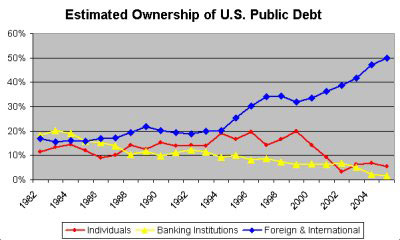
Of course, foreigners are financing most of this deficit spending. Williams notes that last year alone, foreign investors bought enough federal debt to cover all the debt issuance of the U.S. Treasury. But we have no assurance that this will continue. Indeed, once this foreign buying even begins to slow, U.S. interest rates must rise to finance our debt, the interest costs on which are already running at nearly $3 billion per day.

As Deepcaster has repeatedly noted, this process will eventually lead to a very high rate of inflation, high interest rates and a very sharp decline in the dollar, likely followed by a deflationary depression. Williams notes (consistently with Deepcaster's view): "Once the selling pressure starts it's going to be massive. You're going to see a lot of dumping of U.S. securities, particularly Treasuries."

"To absorb them you're going to see a sharp spike in rates or the Fed will step in, provide liquidity in market………..the end result, when it does all come together, will be something akin to hyperinflation. But at the same time, you'll also have a very depressed economy." …That possibly could evolve into a hyperinflationary depression as much as I hate to use that term."

Williams concludes by saying "so we're talking about a global crisis of unprecedented proportions. Probably one that could lead to the collapse of the current currency system."…As crazy as it sounds, I think the only thing they will be able to do is go back on some kind of gold standard." And, indeed, gold is the Bedrock Asset so far as Deepcaster is concerned. And this is why the Fed-led Cartel makes such forceful efforts to cap its price.

Finally, Williams talks about where we are today. Indeed, he says we are already in a recession. "What I found is that if you adjust the real GDP numbers that the government releases for the myriad revisions and redefinitions…you'll find that there is a happy overstatement of growth of about 3% on a year-over-year basis. The problem very simply is this - - the consumer is the primary driving force behind economic activity and the only ways that consumers can fuel consumption growth are through rising income, debt extension, or savings liquidation, that's where he gets his cash."

But the consumer is not really seeing any income growth. “Now this is where the playing around with numbers really gets good.” We've already talked about hedonics and all the other manipulations of the CPI. But they all pale next to the impact of imputations in the GDP that are an outgrowth of the theoretical structure of the national income accounts.

“Any benefit a person receives has an imputed component…when the government puts all of it's imputations into income, its growth generally remains positive and has very little relation to reality."

How do we know when the end is near? Deepcaster and Williams agree on the answer. "If I were looking for one factor to signal the onset of some really serious problems, I would watch the dollar. If you start to see a sharp sell-off, or if the selling starts to pick up a little steam and begins to look like a panic, or you start to hear talk of an Asian country dumping a little extra in the way of dollars, it will be a sign of really bad times to come."

And Williams' excellent analysis raises a further question which Williams does not address, but which Deepcaster does address. When the resulting (and nearly inevitable) crash appears near, what "cover" or "incident" will the government leaders then-in-power, create to deflect the public’s justifiable rage away from the numbers manufacturers and manipulators themselves who caused the crisis in the first place?

US drowning in paper and sinking toward recession

President Bush has signed the $US 781 Billion increase in the US Treasury's debt ceiling. With US fiscal 2006 (which ends on September 30, 2006) not yet half over, the increase for the Treasury's "debt to the penny" for the year is already $US 430.8 Billion. One dollar in five the US spends is borrowed.

No wonder that Gold did a moon shot Friday, up  $US 9.70.

The Dow remains frozen. The yield curve on Treasury debt is again inverted.
The US budget deficit for February $US 119.2 Billion. January trade deficit $US 68.5 Billion.

The world is stuck with $US 11.154 TRILLION in US financial paper assets, a figure close to US GDP.

New home sales in the US in February fell 10.5%, the biggest monthly drop in almost nine years giving the US the biggest inventory of unsold homes in more than ten years - since January 1996.

In Australia new home starts for the last three months of 2005 were down 20% from their peak during the first quarter of 2004. New housing starts in Australia have fallen in six of seven quarters up to the end of 2005.

Interview with John Williams

On Thursday evening (3/23), John Williams was interviewed by Tom Jeffries of HoweStreet.com, Vancouver, British Columbia. The interview covered John's views about the serious inaccuracies contained in US government economic data, as well as thoughts about the current condition of the US economy.

The interview runs about 25 minutes, with the audio available at "John Williams HoweStreet.com March 2006 Interview."

And for those who are not familiar with John's highly proprietary research work, listen to Tom Jeffries' interview, then be sure to visit John Williams' Shadow Government Statistics.

March 24, 2006

http://stopwaroniran.org/petition.shtml

Stop the war on Iran before it starts!  
It is with grave concern that we observe the growing threat of a new U.S. war--this time against the people of Iran. The media is filled with reports of an alleged nuclear threat posed by Iran and the assumed need for the U.S. to take military action. These reports recall the "Weapons of Mass Destruction" stories issued in the months leading up to the war on Iraq.

THE FIBONACCI FORECASTER

Edited By Jeff Greenblatt
March 23, 2006
Greetings:
The email I always seem to get from people is how can they learn more about Elliott.  My answer is to learn from the best.  I spent years following every single move Hochberg made until my forecasts were posted in Club EWI and some of them actually worked out BETTER THAN WHAT THEY WERE DOING.  They took notice, but that's another story.....
My website and ebook with the unique and original methodologies will be ready soon enough so long as I can stay out of the hospital, but until that time comes I have an idea to share with everyone.  This week is another of those FREE WEEKS at EWI.  I happen to admire great Elliotticians the way some people look at a great painting.  For the past couple of days, I've been admiring the work of Jeffrey Kennedy who happens to run the Futures desk over at EWI.  Say what you want about Prechter and their terrible forecasts over the past few years.  One thing they do have is excellent analysts on their staff.  For those of you who are new to Elliott or at an intermediate level I recommend very highly that you download ALL of Kennedy's charts.  Download the monthly Futures report then go to archives and download the past 5 daily reports which specialize in a smaller time scale.  After you do that go over ALL of his charts.  Look at how he puts the wave counts together.  It does not matter if you are interested in cattle, sugar, cocoa, etc.  This is a process that will take weeks if not months.  If you do that, I guarantee you will take your own wave understanding to the next level.
While we are on the subject of FREE WEEK, did you see Prechter's new Theorist?  He has an interesting chart and comes clean on one of his own blunders.  He presents a chart of the Dow in terms of  gold.  On this chart he makes a case the Dow has actually lost half it's value since the all time high in 2000.  I happen to think this chart is quite good.  Those of you who are socionomic students know the President's popularity rating is generally tied to social mood and the rise and fall of the markets.  So how can Bush's rating be so low while the Dow is within a few hundred points of its all time high and the SP500 is at a 6 year high?  This chart explains it.  Unfortunately for EWI the Dow is NOT measured in gold but rather in terms of the dollar.  Prechter FINALLY comes clean after all these years to tell us the wave pattern in the Dow from 2000-2002 was corrective and there is now the possibility of an all time high yet to come.  He makes the case the 2000 high MIGHT be a 3rd wave top.  Thank you very much.  It has been stated right HERE, at least 6 months ago and perhaps as long as a year ago the Dow bear was very choppy, looked corrective and may have led us to a 5th wave extension as the bear bottom in 2002 curiously ended in the vicinity of the 1998 low which also happens to be the fourth wave of one lesser degree.  This may or may not happen as that 2000-2002 wave can still be an A wave down of a larger ABC bear market but the bear market MIGHT NOT BE OF GRAND SUPERCYCLE DEGREE as Prechter contends all of these years.
THE STOCK MARKET
Last time I discussed a change of stance based on a number of factors.  I also mentioned two mitigating circumstances which were a lower probability.  One of these happened to have been a potential bullish expanded flat IF THE NDX WERE TO BOTTOM near 1660.  The figure I put out was 1662 and it stopped going down at 1660.81. So as crazy and illogical as this seems, for the time being the charts have pulled a rabbit out the hat and have stopped going down EXACTLY WHERE THEY NEEDED TO. Those of you banking on this lower probability play, good luck to you.  You'll need it but the funny thing is it can't yet be ruled out.
What happened today opened the door a bit further for your scenario as the Futures and NDX took out yesterday's low but the NASDAQ DID NOT!  One thing I've observed over time whether to the bull or bear side if the group of indices are not all on the same page the trend might poop out.   For now, the intermarket divergence has a new NDX low not being confirmed by either the NASDAQ or the SOX. 
All is not lost for the bears either.  Check out the SOX chart.  The other day we experienced some real choppy action that I said needed time to sort out because it apparently did not make any sense.  The highest probability right now is the SOX has a developing running triangle that is not yet complete.  A running triangle is one that sets a low(high) for the trend, pushed in the opposite direction and makes yet a new price extreme for that trend that is actually just the B wave and not the 5th wave low.  IF this outlook is correct, the chart will now top between 505-510 and turn down.  Taking out the high at 510 on 3/21 would invalidate this pattern. Assuming a lot for now, if this pattern is right, the thrust measurement would take it down to the 470-475 range where there is a larger cluster of support where it could stage a bigger rally.  If it were to bottom at 471 it would have had a move of a perfect Fibonacci 89 points.  We are speculating here of course but if the SOX is in a bearish running triangle the lower probability expanded flat pattern in the NDX would ultimately fail as the SOX would take the NDX along for the ride.  This pattern has quite a butterfly effect so that will be on the top of the laundry list to watch tomorrow.
The SP500 could be developing a sideways pattern of its own along with the Dow.  I wish I had something more interesting to tell you on that front.
BOTTOM LINE:  We now enter the turn window of the 233rd day off the April low from last year.   With the NDX at a fresh low today, we have made a low within one day of the window.  That would be the other mitigating factor.  When this window closes we will then be in the FED ZONE which almost always brings fireworks.  For now, it appears we start off HIGHER as in any event the SOX would still need upward motion to complete that triangle but also we are dealing with that intermarket divergence.  Then we watch and see what happens.  If the SOX blows out the triangle, we will probably get a retest or new highs but if the triangle completes, we get another small degree leg down. 
AUSTRALIA
The All Ords took out 5000 which means our forecast is on track.  It looks like it has a collision course with the upper trend channel as well as the 160-62 week window.  A new YTE reader wanted to know why the short commentary.  There are times when there is much to say and other times less is better.  Those of you who are new will come to learn in time these charts have magnets attached to them.  Once they elect a path they won't stop until they come to some cluster of Fibonacci time and price points.  The point is NO momentum indicator will stop it.  Why do some charts stay seemingly overbought or sold for extended periods of time only to reverse abruptly?  When the chart hits the time window, that's it.   In this case, the waves have been hard to count as the chart keeps going but the upper trend channel line is near 5100.  Since it's already Friday we are on the cusp of the window near the top of the channel.
GOLD, SILVER AND THE XAU
I was looking for stiff resistance on the Silver chart at 1060.  We've surpassed that as we are sitting at 1068.  Silver has fulfilled the recent forecasts for continued bullish activity.  We are now hitting a cluster of relationships (3) so we'll see what happens.
Gold is in a more complex situation as discussed on Tuesday.  The bullish candle formation that formed on Tuesday's close came to naught as we took out that low.  The wave pattern since the recent high is very choppy and why I think it is a B wave in an ABC up.  Today we turned up on the 55th hour off the low from March 10th but did not do so decisively.  We are going nowhere fast on this chart.  From where we sit right now we can get one more low before a C wave up kicks in if I've been right about this.
XAU set the fresh low discussed on Tuesday night.  This looks to completed a small degree 5th wave low but that doesn't mean we are about to have a big rally here either.  All it really means is we can finally have the test of the 135-41 polarity area
BOTTOM LINE:  The only change here could be the XAU could catch a breath of fresh air from the recent inertia.  There is a ton of overhead resistance and it has not proven in any shape or form it will be able to take it out, IF IT COULD GET THERE IN THE FIRST PLACE.  Gold is stuck in a very choppy progression that looks nearly complete.  It would be possible for it to break down here but out of this choppy progression I think it should resolve up as this looks corrective.
US DOLLAR
The dollar held its 50 week moving average much as I thought it would.  Now it is taking the shape of one of those running triangles discussed previously for the SOX.    IF this is the case we are in the latter stages and could be within a couple of weeks of a resolution to a pattern that has been going on for nearly a year.  I put up a new chart that focuses on this possibility and the one of the reasons it might work out is from where I have the 3rd wave high to the C wave low is exactly 29 weeks.  Now we are sitting at 37 weeks as the trendlines converge.  If it was going to break down, it had an excellent chance  just the other day but it did not.
BONDS
We are straddling the 110.56 area in a retest of the low.  This looks to be a very slow moving pattern since last Thursday that has finally reached the 5th wave.  Tomorrow would mark 7 days down and we could get a very sharp reaction going the other way.
CRUDE OIL
Instead of retesting the low, we pulled back up and filled the gap near 65 left between Monday and last Friday.   The whole pattern over the past month is very choppy and while we remain land locked in a trading range I wouldn't be surprised if this ultimately broke to the downside but it still needs at least 3-4 more days of this type of action.
Jeff
 For those of who are new, this is the link you follow to get to the charts.  IF you like what you see, please vote for it at the bottom of my page once a day.
The content in THE FIBONACCI FORECASTER is for educational and informational purposes only.  There is no offer or recommendation to buy or sell any security and no information contained here should be interpreted or construed as investment advice. Do you own due diligence as the information is the opinion of Jeff Greenblatt and subject to change without notice.   Please be advised to consult your investment advisor, attorney or tax professional before making any investment decisions.  Jeff Greenblatt will not accept any responsibility or be liable for any investment decisions based on the information discussed here.

Ha Ha Ha America

From the Sundance film festival.

Silver's Mushroom Cloud: THE FIRST MONTH (Fiction from 2001)


By Charles Savoie (copyright 2001)

Most of us know that a mushroom cloud is an effect seen after a nuclear blast. Silver having been subdued for virtually a generation, the time is fast approaching that low silver prices will end with an explosive termination upwards. There have been minor fireworks in silver occasionally, as the brief spike after the Buffett purchases in February 1998, and the blip up to $5.95 just after the Washington Agreement in September 1999. Due to the severe imbalance between production and consumption, which has been aggravated by powerful forces acting in concert to hold silver low in the face of the catastrophic decline in supplies, and other factors such as attempts to call in leased silver and naked short positions being impossible to cover, silver is now poised for a climb into the stratosphere---the most precipitous sustained rise in commodity history. Unlike the 1979-1980 episode, this time there will be no retreat to low prices after the big blast. Based on figures available from the Comex, Apex Silver and Personal Finance, the Comex warehouses contain only 3% of the silver necessary to rewire the U.S. power grid for superconducting power transmission, to say nothing of all the other unrelenting demands on silver consumption. Other advanced nations are also moving towards superconductivity. (The Apex 2000 annual report says one ton of silver per mile will be needed, whereas another authoritative source claims only 400 ounces. This is a case of mutual exclusion---let the reader decide who is in error. Even without superconductivity, we are still in a hole to the extent of at least 100 million ounces per annum, and when leasing stops, the unfulfilled demand is far more than sufficient to create a buying panic in silver!) What follows is a speculative account of events during the first month after the blast off in silver prices begins. It could commence in late October to December 2001 while NYSE stocks are probably in a free fall, succumbing to the same contagion factors, and a new assortment of economic negatives, which crushed the NASDAQ from over 5000 to a recent low of 1683. Against this background of economic disease and crushing public and private debt, the banking panics of the overleveraged financial system await the eruption in precious metals prices to act as the lit fuse, and, along with a dollar set to drop like a rock, will throw napalm onto the precious metals fire. No doubt the public will be called upon to bail out those involved in the gold carry trade, and as the Fed inflates the supply of dollars, inflation will reappear with unbelievable fury in gold and silver. A new confidence in precious metals as wealth and medium of exchange is soon to become prominent in the public mind, as they witnessed the severe depreciation of other assets.

Day one: silver opens on the Comex at $5.50, having drifted up from late summer lows. After the lunch hour a major leasing source announces its silver is exhausted. Prices jump to $6.75 by the sessions close. The next morning prices continue sharply up as a short covering nightmare unfolds. Unhedged silver equities surge 150 to 425% in 2 sessions. Silver passes $8.25 by days end. Gold is over $375 and climbing; platinum and palladium are north of $550. Daredevil stock traders who could not quit while they were ahead make another handsome haul by selling into the biggest rally yet, but as they watch for a price pullback, which never comes, they are shut out of additional gains and future dividends. There is no dip available to re-enter the market at lower levels with a larger position. Silver moves up strongly on a daily basis, and attempts are made to call in silver leases, which aggravates the crisis. All leasing stops abruptly, and all hell breaks loose in the silver market. One of the meanest hornets nests in financial history is unleashed! Bullion banking goes belly up, and several members of that occupation flee to nations without extradition treaties. Limit moves daily are not news as much as the word that silver is beginning to trade in a cash only market. By the end of the second week of the crisis, many industrial users cannot get delivery of metal, and the unbridled buying panic erupts---the sun catches on fire! Its deja-vu late 1979 again, except that many market participants realize this time, the crisis is exponentially worse: prices are soaring and supplies do not exist to bring the price down, so defaults are rampant. Lawsuits are filed, and silver users mess squealing worms while raving to the CFTC and Comex officials that they have to halt the alleged speculation in the silver market, still attempting to deny that a physical shortage has finally caused the price to move. Comex officials institute the rule change which wiped out the Hunts in January 1980óthey place a freeze on buy orders for silver, but this does not stop the crisis, as the physical shortage is real, and the rule change is scrapped within 2 sessions; other meddling rule changes are contemplated, but no rule changes can cure the shortage! Shareholders of corporations dependent on silver are faced with sharply declining share prices, just like 22 years ago (New York Times, February 3, 1980, section III, page 2, column 3; and Forbes, December 10, 1979, page 124). And that, after the first shock wave of NYSE declines; rolling power blackouts, layoffs, severe winter weather in the Northeast and ominous news from overseas adds to the gloom. Employees of silver consuming manufacturers face layoffs due to the raw material shortage. Holders of short positions ride a razor blade into a pool of acid in the derivative meltdown, as they cannot conjure real silver out of thin air! Forward selling treachery on the part of management guts stockholders of heavily hedged companies; a class action lawsuit will eventually reach the Supreme Court. Australian lawmakers are besieged by devastated stockholders of short selling companies. A Senator asks the Federal Reserve and the Treasury to intervene, but they have no silver; Greenspans wrinkles look deep enough for planting watermelon seeds. Investors holding physical silver smell blood in the water and are gloating, refusing to sell as the price climbs higher. Silver is now an absolute powerhouse and dynamo of wealth! Many have the attitude of holding their metal until the Grand Canyon is gone! The skyrocketing price of silver bulldozes all opposition like General Sherman marching through Georgia! Just one small Mercury dime, 1916-D in MS-70 condition now buys a nice middle class home. As Arab oil money moves into silver (exactly as it did before, New York Times, April 19, 1980, page 29, column 6), smart money from all over the world from Asian exporters to European manufacturers scrambles in a mad frenzy to get into silver and gold, realizing the price can only move higher on a sustained basis. Platinum and palladium charge past $1,500 per ounce; rhodium surpasses $7,000. Angry protestors in a vile mood picket the Bank of England daily over the disposal of their national gold treasure at far lower prices. On the floor of the U.S. House of Representatives and in the Senate, legislation is introduced to either de-list silver from Comex trading, or to force the Comex to not interfere with a new, free market in silver prices. Officials of the CFTC, NY Mercantile Exchange, Silver Users Association, hedge funds and silver mining company executives are summoned to testify at Congressional hearings concerning the suddenly recognized silver shortages, and how years of naked short selling have deepened the crisis by choking off production. The Gold Anti-Trust Action Committee becomes widely known to Americans, and Theodore Butler is invited to testify before Congress concerning his warnings about the silver manipulation, which appear in the public record on the Internet. A panel of experts including David Morgan and Robert Chapman are invited to write a series of editorials to appear in the newsletter of a national businessmens association concerning events in silver, and their suggestions for monetary reform of America. Consumers deluge retail stores, emptying the shelves of silver based items like film and mirrors, whose prices have been hastily marked up. Jewelers are accused of price gouging as they are forced to add steep mark-ups to their gold and silver items, so as not to sell below replacement cost. Hotel and motel operators are on the alert against guests stealing mirrors. A medium scale silver user is arrested in a scandal of attempting to bribe a funeral home chain operator to steal silver amalgam fillings from the deceased. All electronic products containing silver have fat surcharges imposed by manufacturers, exactly as in the last crisis (New York Times, Sunday, February 7, 1980, section IV, page 8, column 6).

By the middle of the third week, silvers rapidly expanding mushroom cloud tops out in the stratosphere, and casts an immense shadow over world markets. Real estate prices have started a steep decline. Distinguished professors of economics at super rich sponsored universities begin writing scholarly articles for arcane journals with tiny readership as to why the cataclysm in silver and gold prices has happened. Financial commentators for CNBC tilt their heads like bewildered puppies as they make remarks concerning how they just don't understand why precious metal should have ever appreciated. A previously unknown, self constituted expert a la Martin Armstrong will charge that Comex silver was all moved to London, where it is so abundant as to be coming out of the cracks in the pavement; yet United Kingdom manufacturers are on a rationing system. The voice warns that silver is in danger of falling below the price of manure; but the marketplace screams otherwise. (Melanie Johnson, Member of Parliament, admitted in a letter dated 11 December 1999 that the British government has no silver reserves, see www.gata.org). Representatives of developing nations without silver resources of their own protest to the United Nations that the developed countries are soaking up all silver production. The abrupt transition to sharply increased prices fails to unleash nearly as much scrap silver going to refiners from the public as would have been thought by some, as most of that overhang was eliminated 22 years ago. Silver disposals are tiny in contrast to the fantastic demand. Investors too numerous to count already disinvested themselves of their silver before the aggressive up-tick, having thrown in the towel in the long wait for escalating prices. Mexico and Peru both announce a total embargo on export of their silver, exactly as they did in 1979, additionally becoming buyers for their central bank reserves (New York Times, October 19, 1979, page 8, column 3 and Fortune magazine, High Stakes in the Silver Game, December 17, 1979, page 57). Consensus in the Mexican senate is reached that the nation needs to begin circulating silver coins again, and going to a Silver Standard is urged throughout Latin America. With Cuba the only Marxist regime in this hemisphere and not being a silver producer, caution is urged that miners receive market prices for their metal. India, never forgetting the negligence of Union Carbide in the Bhopal poison gas disaster on December 2 and 3, 1984, which caused 16,000 deaths, thumbs its nose at the Silver Users Association, of which Union Carbide is a member. India announces it will not export silver at any price, since they need it for their own infrastructure, repeating their actions in the crisis a generation ago (Fortune, December 17, 1979, page 57). This also presents India a chance to smirk at the United States in retaliation for the sanctions imposed by the Clinton administration over Indian tests of 5 nuclear devices in May 1998. Pleas from the Bush administration for India to release quantities of its silver are rebuffed, with the Indian ambassador repeating statements made in the wake of the crisis a generation ago that it has taken India centuries to accumulate its silver, and that they will not squander it (National Geographic, September 1981, page 307). Treasury Secretary Paul O Neill, formerly a director of Eastman Kodak, finds himself powerless to influence India, Mexico and Peru to release silver. By this point silver has already exceeded $50 per ounce, and moves beyond $75 at these announcements. All this having happened within a matter of a few weeks, the investing public, which was burned badly by Nasdaq and Dow Jones price declines, begins a pay any price stampede into physical silver and silver equities, like trying to get all the water in Lake Superior through the nozzle of a squirt gun. Gold is north of $700 per ounce while silver narrows the value ratio, but average investors, millions of them, find that the selection of quality silver mining corporations is alarmingly small, and their shares are climbing like rockets in proportion to the sudden, fantastic increase in their asset base. Investors who bought while artificial low prices were still in effect are suddenly, but solidly, rich. The same analysts who hyped bloated, near worthless securities of dot-coms with no income and tiny assets and steered tens of millions of people into ruin, are now doubly recognized for the travesty of their alleged expert status, as they failed to alert the investing public to the inevitability of silver/gold wealth impending. Back in 2000 when the market cap of Cisco was $555.4 billion for a day, some of those simple minds perhaps thought that each share was going to be worth $555.4 billion in a few more trading sessions. They believed all they had to do was invest in tech and software stocks and their investment would be raised almost literally to the power of infinity! Instead they got a lot of margin calls, some even borrowing on home equity to buy shares at the zenith of the bubble now residing in apartments. Investors who bought such stocks near the top, then rode them all the way to the bottom, feel desperately sick to see the so-called barbarous relics, silver and gold, climb to such commanding heights, and wonder why they could not see it coming, in spite of the publicized actions of various billionaires moving into silver many months earlier (Forbes, August 7, 2000, page 64 and other sources). With the facts of long-term short corner manipulation becoming more widely known, consumers organizations demand to know why market participants held the price low for years, making a gradual transition to higher prices impossible, and creating end-user product shortages. With the heat on, some regulatory agency officials think how more comfortable life would be in Algeria. The Dow has wilted below 7,000; the Nasdaq has shriveled to 950. With silver prices escalating daily, holders of physical withhold their metal from sale, taking a wait and see approach to see how high the chart will go. A deliriously happy silver investor sees a billboard while driving down the highway, and thinks, thats the size chart will be needed to plot silvers rise! By holding their silver back, victorious silver investors add more pressure to the silver environment. USA Today reports the sale of a $175,000 sports car for a pile of average circulated Franklin half-dollars. National news reports a woman who sells a few thousand silver mining shares, and buys enough fine diamonds to fill Hoss Cartwrights ten-gallon hat. An investigating Senator remembers all the silver dimes, quarters and half dollars he saw as a young man, and is haunted by the memory.

By the end of the fourth week after the silver blast-off, the Middle East blows up again, worse than before, with Israel a nonstop maelstrom of turbulence. An Islamic military alliance led by Iran invades the Saudi oilfields, having overrun Kuwait first. Petroleum stages a monumental upward spike, driving airline stocks to the ground (is this why investor David Bonderman announced his sale of 1.1 million airline shares in late August?) As happened almost 22 years ago, sharply rising precious metals prices are partly attributed to Middle East tensions and references are made to World War III (Time, January 14, 1980, page 57). We are now witnessing the most awesome price surge in commodity history! While world attention is focused on the new Middle East crisis, China bombards Taiwan with missiles for 5 hours then follows up with a massive invasion. The Reds secure control of the one time Portuguese colony just as Americans are waking up. With military tensions concerning China adding fuel to the Middle East firestorm, silver surges past $275 an ounce on the open market, and gold moves beyond $1700. Heavily hedged Australian miners are as dead as Julius Caesar! There is no more foolish talk from the Gnomes of Zurich concerning China dumping tons of silver on the world market. The Dow has plunged below 6,000 and the Nasdaq skids to 775. In contrast, certain Canadian Venture Exchange stocks, and the XAU Index, stand out like the Colossus of Rhodes! A war erupts between industrial silver users and nations withholding their silver from export. A consortium of international financing institutions offers to trade Latin American debt for silver, gold and platinum exploration rights. Shareholders of the best-positioned mining companies see their shares up a mind-blowing 60,000% due to horizontal leverage (number of ounces per share) and 25,000 buyers to every 1 seller in a global bidding war for more silver than is possibly available! Men like Gates, Soros, Kaplan, Buffett, Bacon, Fleckenstein and Tisch are vilified as vultures in some sections of the press by those who secretly envy them, and those who held silver prices below cost of production for so many years accuse the longs of engineering the crisis. Subscribers of a well-known publication want to know why it featured the viewpoint in its November 2000 issue that silver was dying as a precious metal because of alleged oversupply in the face of a well-publicized 11 years of huge deficits. Congressional hearings attended by generals, admirals and defense contractors begin concerning the depletion of silver in the U.S. Strategic Stockpile (Reuters, November 27, 2000) and why silver prices were held so low for a generation while supplies dried up, causing the crisis by making production unprofitable. Douglas Dillon, the Treasury Secretary who took the U.S. off circulating silver in 1964 after the Johnson administration denied it was going to do so, turns over in his grave. The late Treasury Secretary William Simon, of 1979-1980 Comex management, is not nominated as someone whose image should appear on silver commemorative coins. Silver rationing has been in effect for 2 weeks, with only industries vital to national defense getting it on a steady basis, plus users of medical x-ray film. A medical research team reports that silver destroys a deadly virus after antibiotics fail. In newspaper classified ads, silver based film is offered by many persons for huge premiums over what it cost a month earlier. Shareholders of highly leveraged, unhedged silver producers are gloating like a gladiator over a disemboweled opponent, as they realize that they hold title to what little silver is left in the crust of the earth, over 80% of it having been mined and consumed already (National Geographic, September 1981, page 313 and The New Boom in Silver by Jerome Smith, 1983, pages 32-34; one of the well known companies has a mine discovered in 1864 and another discovered in 1880). Management of these silver companies who avoided the mistake of being in production at or below break-even prices, suddenly has stock options collectively worth over $75 billion and surging upwards, as they are sitting on assets worth over 3,500 times the market capitalization of their companies only a few months earlier. In Vancouver and the Cayman Islands, toasts are made to the new patron saint of the silver boom, Sir Francis Drake (1540-1596), the Englishman who raided Spanish treasure galleons and plundered precious metal taken from Rio de la Plata (Silver River) on the coast of Peru. After 5 more months the gold/silver ratio has suddenly narrowed to 6 to 1 with silver leaping above $500 per ounce. The prospect is now on the horizon of silver passing gold in price! The crisis culmination of some 5,000 years of silver mining and consumption is a stunning bonanza for those who saw it coming and took positions before silver went into orbit, as the exploding world population combined with shrinking silver resources has created an opportunity for wealth unprecedented in history! Governments and individuals are forced to acknowledge that silver is not only an absolutely vital commodity in a desperate supply squeeze, but that it is indeed, along with gold, in and of itself, money, medium of exchange and currency in the truest sense of the word.

March 23, 2006

New high for Copper

copper24.gif

Spot Uranium rises to US$40.50

Up from $30.00 last October. The Most Bullish metal of all.

March 22, 2006

Can't beleive what I'm reading..

"One Bush adviser sees political promise for the President in a nuclear peril. ‘Certainly, there's going to be a serious showdown on Iran,’ he said. ‘He's very relevant on that, and that may help his numbers a little bit.’"

--Time Magazine, March 14, 2006

getting near the end..

ANNANDALE, Va. (MarketWatch) -- A couple of investment newsletters in recent days have drawn readers' attention to a subsurface pattern in the market that has very curious implications for where we are in the market's cycle.

It seems that in recent months, stocks of companies with the strongest balance sheets have markedly lagged shares of firms with the weakest financials. In fact, it has not even been close.

Late last week, for example, Richard Moroney, editor of Dow Theory Forecasts, reported that, so far in 2006, the ten percent of stocks scoring the worst according to measures of "debt levels, interest coverage, and profit margins" have gained nearly 13%, versus a less than 5% gain for the ten percent of stocks at the opposite end of the spectrum.


Moroney reported a similar pattern when stocks are ranked according to "three- and five-year growth rates, along with return on equity, assets and investment." The 10% of stocks scoring the worst on these dimensions have gained nearly 11% so far this year, in contrast to 1.4% for the 10% with the best scores on these dimensions.

In a similar vein, Standard and Poor's reported Monday that "stocks with average to low S&P Quality Rankings (B+, B, B-, and C) have continued to outperform those with high Quality Rankings in recent months." S&P's Quality Rankings are based on dividends and the quality of earnings.

What does this mean? As best as I can determine, the historical pattern is for low-quality issues to outperform the high-quality issues both at the beginning of a bull market and at its end.

Take your pick.

Consider first what happens at the beginnings of bull markets. That's typically when the economy is just emerging from a recession and economic growth is beginning to pick up momentum. Such growth will have the most dramatic impact on companies living at or close to the financial margin, since they are the ones whose very survival was most in question during the recession.

To be sure, it takes a while for this revived economic strength to filter its way down to companies' bottom lines. But the stock market is a discounting mechanism, and it doesn't wait for those balance sheets to improve before bidding these companies' stock prices strongly higher.

Hence the strong relative strength at the beginning of bull markets of stocks of companies with the lowest financial quality.

At the other end of the spectrum, consider that bull markets often come to an end in a speculative blow-off. Ironically, the companies that typically are the beneficiary, temporarily, of such speculative excesses are the lowest-quality companies. There no doubt are many reasons for this, but one is that higher-quality companies cannot possibly satisfy the demands for earnings and revenue growth demanded by an increasingly greedy investment public at that stage of the market's cycle.

By way of example, I need only remind readers of the Internet bubble of the late 1990s and early 2000.

Which of these two extremes is more likely to apply to today's markets? It would seem difficult to argue that we today are at the beginning of a new bull market, since by almost all counts we are in the fourth year of the bull market that began in October 2002. So by process of elimination we are left to conclude that we must be close to the end of a bull market.

If so, then the best that the bulls can hope for right now is that the outperformance so far this year of the lowest quality issues is merely temporary and doesn't represent a meaningful trend. I interpret this to be Moroney's meaning when he writes in his latest issue: "In our view, strength in high-quality blue chips is exactly what the broad market needs."

Are there any signs of a high quality revival? Richard Tortoriello, a quantitative equity analyst at S&P, thinks there are. He notes that the "rate of [the lowest quality issues'] outperformance has [recently] slowed."

In other words, though the lowest quality issues are still beating the highest quality ones, they aren't beating them by as much as they were before.
To be sure, this is not much more than a glimmer of hope at this point. But, when interpreting the marked relative strength recently of the lowest quality issues, this glimmer is about all that the bulls can point to.

Xstrata after Oxiana?

Copper miner Xstrata was another rumored potential predator in the sector as speculation emerged that the company is about to launch a bid for Australian copper and gold company Oxiana, according to mining analysts at Investec Securities. Oxiana closed up more than 10% in Australian trade