« March 2006 | Main | May 2006 »

April 30, 2006

Follies Video "Every Breath You Take" a Cult Hit with Financial Media

April 28, 2006

The cast and producers of the Follies’ video “Every Breath You Take” were featured on CNBC’s Power Lunch today, as appreciation of the small masterpiece continued to spread over the Internet and through the media.

In his starring role in the student revue as Dean Glenn Hubbard, student Michael O’Rorke lip-synched a creatively worded spoof version of The Police pop hit to Chairman Ben Bernanke of the Federal Reserve Board. Outgoing GBA president Cabe Franklin provided the vocals.

The video got its nationwide release on April 25 when it was featured on CNNMoney.com’s EyeOpener newsletter. It has also appeared in the Washington Post and on CNN.

What was the price of gold then

Whether as the basis for the monetary unit of a country, or in its role in comparison to the currency price of silver, the price of gold has long been a subject of great interest to both the scholar and the general public. Below are five series for determining the value of gold historically:

  • British Official Price for the years 1257 to 1945
  • U.S. Official Price for the years 1786 to 2001
  • New York Market Price for the years 1791 to 1998
  • Gold/Silver Price Ratio for the years 1687 to 1998
  • London Market Price for the years 1718 to 2001
  • April 28, 2006

    Stay Long Commodities

    Will there be commodity class corrections ahead? Sure, and some may be quite violent. But at least for now, we'd continue to view these as buying opportunities as we believe the Fed and the central bankers are trapped. They are trapped in a set of circumstances they themselves spawned. Unwilling to allow prior period misallocations of capital (stock and housing bubble) to reconcile themselves, they have implicitly committed to facilitating ever larger amounts of liquidity support to the financial markets and theoretically real economy. But it seems to us that they have worked themselves into a corner now being that the harder they push on the liquidity accelerator, the harder they will have to yet push in the future to offset the real world inflationary costs of commodity prices their hedge, prop desk and momentum trading former friends are now supporting with the very liquidity the Fed creates in the first place. The veritable Catch-22? As the data above tell us, this liquidity is now squarely finding its way into the commodity complex and that process is accelerating. Can it continue on forever? Of course not. We continue to believe that US consumers will slow ahead, especially given our viewpoint that US household financial well being is negatively correlated to commodity prices, but anticipate that the Fed will ultimately panic and up the liquidity creation ante even further as they have in the past out of fear as consumer slow, again, playing right into the expectant hands of the financial sector who has been conditioned time and again to expect this very response from the FOMC. Who is the best friend of the current commodity bull, who is for now the longer term supporter of this trend, and who in public refuses to acknowledge what is plain for the entire planet to see in terms of forward inflationary pressures? The Fed and the US credit markets. Who else? Until this changes, stay long assets that benefit from inflationary trends, particularly those assets that have not already been significantly levered. Some day the Fed will change tactics. Some day they will realize the speculative financial community has played them for the fool. But we're not their yet. For now, the hedge, prop desk and momentum trading crowd are betraying their liquidity benefactors out of natural self interest as they pile into hard assets and hard asset related investments. We can only believe the Fed and their global central banking brethren are watching this in horror. Paralyzed and reverting to the only trick left in their bag - liquidity facilitation. But after all, the hedge, prop desk and momentum traders are only doing what the Fed has taught them to do for literally years now - put the Fed into a box of being forced to create and facilitate ever larger amounts of liquidity and credit. The financial sector servant of old has now assumed the role of master. You better believe it's different this time.

    To bring the dollar down a little, let Russia and Iran price oil in euros

    From Russia, you might say, with love. This weekend, Alexei Kudrin,
    Russia's finance minister, dropped a bombshell in Washington.

    Attending the annual meetings of the World Bank and International
    Monetary Fund, Kudrin caused his American hosts discomfort by openly
    questioning the dollar's pre-eminence as the world's "absolute"
    reserve currency.

    The greenback's recent volatility and the yawning US trade
    deficit, "are definitely causing concern with regard to its reserve
    currency status," he said. "The international community can hardly
    be satisfied with this instability."

    Kudrin's intervention coincided with another meeting, also in
    Washington, of finance ministers and central bankers from the Group
    of Seven - which doesn't include Russia.

    Top of the agenda: the effect of ever-rising oil prices on inflation
    and interest rates.

    G7 countries are worried the spiraling price of crude -- which
    closed at $72.79 a barrel on Friday and which has now trebled in
    three years -- could inflict real economic damage. The US Federal
    Reserve, in particular, has been forced to take drastic action --
    raising interest rates 15 times since June 2004 to keep inflation in
    check.

    Given that fragility, it is significant that Kudrin is now wondering
    aloud if the long-standing dollar hegemony can last. For him to do
    so is to highlight that America is vulnerable should that status be
    lost. That's because Russia, with its awesome oil and gas reserves,
    could kick-start a challenge to the dollar's supremacy.

    Most nations stockpile their foreign exchange holdings in dollars.
    The US currency accounts for more than two thirds of all central
    bank reserves worldwide.

    This reserve status means that the dollar is constantly in demand,
    whatever the underlying strength of the US economy.

    And now, with massive trade and budget deficits to finance, America
    is increasingly reliant on that status. The unprecedented weight of
    US liabilities means a threat to the dollar's dominance could result
    in a currency collapse, plunging the world's largest economy into
    recession.

    That won't happen immediately. The dollar has sat astride the globe
    for some time now -- in fact, for most of the last century. But this
    statement from Russia -- a country of growing financial and
    strategic significance -- still caused the dollar to slide. It also
    fuelled speculation that central banks could increasingly diversify
    their holdings away from dollars.

    Kudrin's statement followed news that Sweden has cut its dollar
    holdings, from 37 per cent of central bank reserves to 20 per cent,
    with the euro's share rising to 50 per cent. Central banks in some
    Gulf states have also lately mooted a shift into the euro. Such
    sentiments helped push the dollar to a seven-month low against the
    single currency last week.

    But Russia's intervention will have raised eyebrows in Washington
    because the backbone of the dollar's reserve currency status -- the
    main guarantee that status continues -- is the fact that oil is
    traded in dollars. And that is something the likes of Kudrin can
    directly affect.

    For historic reasons, the dollar remains the
    world's "petrocurrency" -- the only currency for the settlement of
    oil contracts on world markets. That makes the EU and Russia
    dependent on it. But with central banks switching to euros, the
    logical next step would be for fuel-exporting countries to start
    quoting oil prices in euros too.

    The EU is Russia's main trading partner. More than two thirds of
    Russia's oil and gas is exported to the EU. That makes Russia a
    strong candidate to become the first major oil exporter to start
    trading in euros. Such a scenario, in recent years, has become
    theoretically possible. But now, with these latest comments, Kudrin
    has thrust that possibility into the open.

    The G7 meeting was dominated, of course, by concern over Iran's
    nuclear programme. The threat of military action against Iran,
    itself a major crude exporter, is one reason oil prices are now
    testing record highs.

    It is worth noting that Tehran has ongoing plans to set up an oil
    trading exchange to compete with New York's NYMEX and with London's
    International Petroleum Exchange. In the light of Kudrin's comments,
    it is significant that the Iranians want to run their oil bourse in
    euros, not dollars.

    Were the Iranians to establish a Middle-East based euro-only oil
    exchange, the dollar's unique petrocurrency status could unravel.
    That, in turn, would threaten its broader dominance -- which, given
    America's groaning twin deficit, could seriously hurt the US economy.

    Some cite this as the real reason the US wants to attack Iran: to
    protect the dollar's unique position. I wouldn't go that far, but
    the prospect of a non-dollar oil exchange in Tehran is certainly an
    aggravating factor.

    The opening of Iran's new oil exchange has recently been delayed.
    But having spoken with numerous officials in Tehran, and western
    consultants who've been working with the Iranians for several years,
    I think it will go ahead. The exchange entity has already been
    legally incorporated in Iran and a site purchased to house
    administrative and regulatory staff.

    The reality is that as long as most of Opec's oil -- read Saudi
    Arabia -- is priced in dollars, the US currency will retain its
    hegemony. But the opening of an oil bourse in Tehran, which now
    looks likely, will signal at least tacit Saudi consent for euro-
    based oil trading. The US knows this, which is why it is nervous
    about the dollar's status being questioned.

    From the G7's fringe, Kudrin has now touched this raw nerve. This
    weekend's meetings have been dominated by questions of global
    financial imbalance - in particular, America's huge deficits.

    Kudrin's missive comes as central bankers, and currency dealers,
    start to conclude the only way to resolve the massive US external
    deficit is a somewhat weaker US currency. As the IMF itself warned
    yesterday, a "substantial" dollar decline may be needed.

    One way to bring that about would be for the euro to enter the
    global oil trading system. This is unlikely to happen soon. It might
    not happen at all. But the idea is now not only realistic but firmly
    on the table in Washington. Perhaps not with love, but it was placed
    there by the Russians.

    No, It's Not Anti-Semitic


    By Richard Cohen
    Tuesday, April 25, 2006; A23


    During the Jim Crow era, many American communists fiercely fought racism. This is a fact. It is also a fact that segregationists and others often smeared civil rights activists by calling them communists. This technique is sometimes called guilt by association and sometimes "McCarthyism." If you think it's dead, you have not been following the controversy over a long essay about the so-called "Israel Lobby."

    On April 5, for instance, The Post ran an op-ed, "Yes, It's Anti-Semitic," by Eliot A. Cohen, a professor at the John Hopkins School of Advanced International Studies and a respected defense intellectual. Cohen does not much like a paper on the Israel lobby that was written by John Mearsheimer of the University of Chicago and Stephen Walt of Harvard University. He found it anti-Semitic. I did not.

    But I did find Cohen's piece to be offensive. It starts by noting that the paper, titled "The Israel Lobby and U.S. Foreign Policy," had been endorsed by David Duke, the former head of the Ku Klux Klan. It goes on to quote Duke, who, I am sure, has nodded his head in agreement over the years with an occasional piece of mine, as saying the paper is a "modern Declaration of American Independence." If you follow Cohen's reasoning, then you would have to conclude that David Duke and the Founding Fathers have something in common. I am not, as they say, willing to go there.

    Unfortunately, Cohen's piece is not unique. The New York Sun reported on its front page of March 24 an allegation from Alan Dershowitz that some of the quotes from the Israel lobby paper "appear on hate sites." Maybe they do, but Mearsheimer and Walt took those quotes (about press coverage of Israel) from a book written by Max Frankel, a former editor of the New York Times. To associate Mearsheimer and Walt with hate groups is rank guilt by association and does not in any way rebut the argument made in their paper on the Israel lobby.

    There is hardly a stronger, more odious, accusation than anti-Semitism. It comes freighted with more than a thousand years of tragic history, culminating in the Holocaust. The mere suggestion of it is enough for any sane person to hold his tongue. Yet this did not stop the respected German newspaper editor Josef Joffe from stating in the New Republic that the lobby paper "puts 'The Protocols of the Elders of Zion' to shame." He is referring to the most notorious anti-Semitic text of all time. My friend Joffe is in dire need of a cold compress.

    My own reading of the Mearsheimer-Walt paper found it unremarkable, a bit sloppy and one-sided (nothing here about the Arab oil lobby), but nothing that even a casual newspaper reader does not know. Its basic point -- that Israel's American supporters have immense influence over U.S. foreign policy -- is inarguable. After all, President Bush has just recently given Israel NATO-like status without so much as a murmur from Congress. "I made it clear, I'll make it clear again, that we will use military might to protect our ally Israel," Bush said. This was the second or third time he's made this pledge, crossing a line that previous administrations would not -- in effect, promulgating a treaty seemingly on the spot. No other country gets this sort of treatment.

    Israel's special place in U.S. foreign policy is deserved, in my view, and not entirely the product of lobbying. Israel has earned it, and isn't there something bracing about a special relationship that is not based on oil or markets or strategic location but on shared values? (A bit now like Britain.) But I can understand how foreign policy "realists" such as Mearsheimer and Walt might question its utility and not only think that a bit too much power is located in a specific lobby but that it is rarely even discussed. This may be wrong, but it is not (necessarily) anti-Semitic. In fact, after reading the Mearsheimer-Walt paper, the respected Israeli newspaper Haaretz not only failed to discern anti-Semitism but commended the paper to its readers. "The professors' article does not deserve condemnation," Haaretz stated in an editorial.

    An abridged version of the Mearsheimer-Walt paper was published by the London Review of Books and is available online at http://www.lrb.co.uk/ . Read it and decide for yourself whether it is anti-Semitic. Whatever the case, their argument is hardly rebutted by purple denunciations and smear tactics. Rather than being persuasive, Mearsheimer and Walt's more hysterical critics suggest by their extreme reactions that the duo is on to something. These tactics by Israel's friends sully Israel's good name more than Mearsheimer and Walt ever could.

    cohenr@washpost.com

    April 27, 2006

    Has Peak Gold Arrived? Lessons From The Peak Oil Debate


    Roland Watson (The New Era Investor) submits: As someone who has kept track of the “Peak Oil” movement for a few years now, it comes as no surprise that oil prices have risen nearly six fold since they hit rock bottom in the late 1990s. Does this mean Peak Oil has already arrived? Not necessarily, but we note that a final peak in global oil production needs to be preceded by a continual decrease in excess crude oil production capacity. When capacity reaches zero, then Peak Oil arrives. That capacity has been dropping now for several years.

    But what can that current debate about oil teach us about gold? Gold, like oil, has been continuously rising in price for five years. Admittedly, its performance has been poor compared to oil, but does this price mechanism also indicate the mining equivalent of reducing “excess spare capacity” and is it also a prelude to “Peak Gold”? My conclusions led me to believe that these two commodities are similar in terms of a Hubbert’s Peak analysis and in terms of the effects of a peak in global production.

    Firstly, Peak Oil based on Hubbert’s theory of oil production versus reserves states that production goes into decline at about the halfway point of remaining reserves. How does this play out for gold? Based on the United States Geological Survey’s 2006 summary for gold, about 152,000 tonnes of gold has been mined out of the ground since man first dug out those shiny yellow nuggets.

    Furthermore, the USGS estimates a remaining reserve base of 90,000 tonnes. So, from the point of view of peak being the halfway point of reserves, gold should have peaked at a remaining reserve base of 121,000 tonnes (152,000 plus 90,000 divided by 2). When was this the case? Backtracking 31,000 tonnes of global mining output gives us the year of 1993.

    However, a look at the graph below of global mining production shows that gold output merely dipped in 1993 as recession hit the Western nations and then resumed a climb to a new high in the year 2000 (which has not been exceeded since). Now, despite climbing gold demand, mine output has been in decline since then.


    Does this imply 2000 was the global peak in gold production? That would mean that out of a 4000-year time range of gold production, we have a seven-year error in estimating the peak, which doesn’t look so bad after all!

    But we have to understand that just like oil reserve figures, figuring out how much gold has ever been mined and how much remains under the ground in an inexact science. What we can be sure of is that the numbers we are using have never been more accurate as man’s knowledge of the earth has increased.

    Another evidence of a commodity production peak is falling supply in the face of rising prices and demand. In a free market, supply should increase to fulfill demand or demand has to fall. For some years now, the difference between new mine output and demand has been filled by scrap recycling and above ground stockpiles. However, this is where the peak argument gets contentious as the 1990s cutback in exploration is given as the explanation for the recent decline in production.

    A similar argument is given to partly explain the tightness in oil supplies today. Oil plummeted from $25 to $10 a barrel between 1996 and 1998. Exploration budgets were cut and we are apparently suffering the consequences today. Okay, perhaps, but that argument is beginning to wear a bit thin after seven years and prices still at all time highs. Likewise with the production of gold, how long does it take to re-open uneconomic mines and get new ones up and running? Seven years and counting and once again prices are still at multi-decade highs.

    But perhaps the most important warning sign of a commodity peak are major producing countries individually peaking before the overall global peak. In the case of oil, the USA, China, Britain, Norway and Mexico amongst a host of others are at or past their national peak of oil production. We only await the Middle East countries and Russia to join them and complete the picture.

    In the world of gold producing countries the picture is interesting if we examine a chart produced by the World Gold Council. If the reader clicks to that page and scrolls halfway down they will observe the multi-colored graphics for each major country and region.

    In summary, South Africa peaked in the 1970s at 1000 tonnes (yet is still the main producer). The USA peaked in 1998 at 366 tonnes while Australia peaked in 1997 at 314 tonnes. Canada peaked in 1991 at 177 tonnes and Brazil in 1982 at 200 tonnes and so on. These example regions when combined currently produce 40% of the world’s gold. If this 40% declines at 5% per annum then the other 60% has to increase production by 3% just to keep production flat. This is not a pretty picture - unless you hold gold.

    Just like oil, the relatively few “giants” of gold production are being replaced by a host of smaller “minnows”. Just like oil, gold explorers are finding less gold in lower grades of quality. In terms of oil, the gold Ghawars and Cantarells have long been discovered and exploited. It is now basically a mopping up operation at the edges of exploration.

    It seems to me that Peak Gold may well have arrived. When Peak Oil arrives as well, then Peak Gold will be confirmed because increasingly higher energy costs will make many mines uneconomic and gold above ground will become far more expensive than gold shut in underground. Unless, of course, gold vaults into the thousands of dollars to offset energy costs!

    This is what we call the “New Era” of investment. It is an era when hard assets will no longer be taken for granted and seen as cheap and easily accessible. They will become rarer and harder to extract and will remain so for decades to come.

    April 26, 2006

    A Long Time Coming


    By: Theodore Butler


    It has been almost eight months since I’ve been able to write about a dealer short-covering clean out in silver. It seemed like it took forever. No matter how long it has taken, the good news to the blasting to the downside we have just witnessed is that the dealers (including Mr. Big) have used the sell-off as an opportunity to buy back a large number of their shorts. Actually, it’s a little more involved than that; the dealers created the sell-off by collusively pulling their bids on the decline. (If you’re not clear on that, please read some of my previous articles.)

    Now the question becomes, is it done? Have we reached a low risk buy point? I think so, but with the tremendous volatility I can’t say it’s only dimes to the downside, the way I could at 4 or 5 or 6 dollar mark (although it may be). But I can say that there are many, many dollars to the upside, courtesy of a host of reasons not contemplated a few years ago, including the growing potential awareness of the real silver story and the prospective ETF.

    I also get the feeling, whether we have seen the bottom of this silver sell-off or not, that the dealers will be very reluctant to sell the next rally, when it comes, which I think is soon. This should free the price dramatically. I say this because I think the dealers have been taught a lesson they will not soon forget. Most of you know that the lessons you have learned in life the hard way, through adversity, are those that are most obeyed. The dealers, likewise, have suffered heavy losses as a result of the 8 month silver rally and are, in fact, covering at substantial loss for the very first time in decades. I think they are more concerned with closing out their shorts and eliminating continued exposure to the upside, than they are with the losses they have booked. I think they will be reluctant to put their heads back into the lion’s mouth by going short again.

    There are a number of good things related to the dealer silver short covering. In particular, the very recent decline in silver relative to gold, may have created a special opportunity for real gold investors who hold little or no real silver. As regular readers are aware, I have long suggested that gold only investors switch some of their gold holdings to silver (assuming no fresh funds were available for silver purchases). This is no way implied that I thought gold’s price was surely headed lower, but rather that silver would outperform gold, handily, in the future. I still feel that way and the recent gold catch-up to the silver price should give such gold only investors another good switch point.

    Although it may appear that I am suggesting doing a gold/silver ratio trade on a leveraged basis, that is not the case. I am still suggesting a cash only, fully paid for position in real silver, only with the suggestion that if one does not have cash, that the gold be the source for raising the cash. The rational for my suggestion lies in the fact that the strong rise in the price of gold over the past few years allows gold only investors the chance to buy silver at, effectively, single digit prices, compliments of the gold price rise. What matters most is what will prevail in the future and, clearly, I am of a mind that sees much higher silver prices relative to gold. After all, we are running out of silver, not gold.

    Now I would like to present an article by my friend Israel Friedman. Even though I have known him for almost 30 years, and we discuss silver every single day, I have always been able to learn something new from Izzy. I hope you have the same experience. I will offer some comments following his article.


    Crazy Izzy

    By Israel Friedman

    Before I concentrate and write about physical silver, I ‘d like to congratulate Ted Butler on the extremely good achievement he has accomplished with the articles he has written on silver. Even though he says he considers me his mentor and teacher, I must confess I think I have learned more from him. I can’t think of one important issue in silver that he hasn’t introduced and it bothers me that others steal from him.

    We can say that today many investors are very happy that they bought silver and in my private opinion those that buy today at current prices will be rewarded also. Many people have asked me where we are in the silver baseball game. I say to them that we are in the middle of the first inning and the first inning is going to end when silver prices will be at 23 to 25.

    Before you invest in silver you have to do research and decide by yourself is Crazy Izzy right, or the rational Ted Butler or the naked shorts.

    I can give you only my opinion and tell you that silver was never priced at its real value. The price is determined on the COMEX exchange and for them they trade numbers, and at any number or price they sell you a contract, and in the last 20 years they sold naked hundreds of millions of ounces and have made billion of dollars.

    You have to ask a legitimate question why the price on the COMEX doesn’t reflect true value? It is very simple – 90% of the mining companies are public and for them silver is just another product and they sell it only to survive and to make enough money to have good salaries, benefits, and to be reelected as directors.

    If these mining companies were in private hands with the knowledge of rarity and deficit of silver, today prices would be not less than $ 250. No real owner sells merchandise for less than fair value without a motivation.

    Crazy Izzy thinks that they minimum value of silver today is $600. Why $600? The answer is very simple – if the market can pay $600 for an ounce of gold when world stocks are close to 5 billion ounces, why the value of silver should be less with world stocks of half a billion ounces?

    I can give you more and more examples, but the most important thing is don’t invest in silver if you don’t think big like me. You can only make big, if you think big.

    If you decide to invest in silver or you have invested already, you have different ways to invest. In my opinion, it will not take long that we will start to have shortages in silver and slowly, slowly the price will rise to the real value. Remember today’s real value is $600; tomorrow can be only higher, never lower. Why? Every day we have less stockpile on earth and less reserves in the ground.

    You are going to ask a legitimate question – who is going to pay $600 for one ounce of silver? The answer is that the industrial user and new demand will come by the world jewelry stores who are going to start to sell silver as the main article because of big public demand.


    We have in the world hundreds of thousands of jewelry stores, who will need store inventory of at least 500 ounces per store to satisfy the coming public demand. In addition, we must have sufficient silver in the pipeline for wholesale distribution and inventory turnover by the jewelry stores and the manufacturers. All told we are talking about hundreds of millions of ounces annually in new demand.

    So you will come to the same conclusion like me that physical silver is the place to be. Some people will say it’s better on the COMEX where you have leverage. Maybe today, but in a shortage situation they can change the rules and you will have a paper contract that is worth zero instead of real silver.

    My father taught me that it is better to have one bird in hand than ten on the tree, and what is in your hand is the safest.

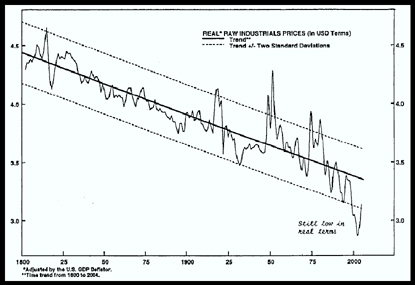
    We are coming to a new era when materials and commodities will do well and other assets will do less well. Lately, we are experiencing a rise in all commodity prices and in my opinion we are only in the beginning of rising prices. The only simple answer is that there is not enough materials in the world to satisfy demand for higher living standards by billions of Indians and Chinese.

    In the beginning, you will not feel too much the rising prices of commodities in finished goods. Why? The cost of a product is changing. In the past the cost of raw materials in a finished product was 20% and 80% was labor, profit, etc. In the future we are going to witness a change in the composition of costs in finished goods – 80% will be for raw materials and only 20% for the rest. Why? The labor in China costs only 5% of what labor costs in the US and Europe.

    Taking everything into consideration I can see silver as a commodity in short supply for years to come and prices higher and higher.

    I’m a crazy thinker and don’t copy me – only after you have made your homework.

    Congratulations, Mr. Butler on a fantastic job.


    Izzy Scores Again

    I thank Izzy for his kind words and especially for introducing a completely new concept, the potential coming jewelry demand for silver. While many are waiting for a replay of 1979-80, namely the dumping by households of unwanted silver objects in response to higher prices, Izzy (and I) see it different. Instead of dumping because of higher prices, we see the public actually wanting to acquire silver because of the higher prices. Please allow me to explain.

    First of all, this is not a new idea from Izzy, as I have heard him talk about it for almost 25 years. It’s just that I have never written about it before, although it always made sense to me.

    Let’s face it, the dumping scenario certainly hasn’t begun playing out yet, at all. Silver has more than tripled from its lows, and I have yet to see any evidence that even one teapot or fork has been melted because of the higher prices. You must remember that many commentators were predicting not that long ago that people would be running out of their houses clutching silver trays at 7, 8, or 9 dollars. Or that our ports would be backed up with boatloads of scrap silver from India. How much evidence do you see of that?

    If great numbers of people were selling silver household objects at current prices, I would tend to dismiss what Izzy predicts. (For the record, while he is the smartest man I have ever known, he is not perfect, and has been wrong on occasions. I say this primarily to keep his ego in check.) But I don’t see many selling silver objects, so what Izzy says is more credible.

    The key is human nature. Most of the time, people love to buy bargains in their daily lives, preferring to shop for what they need by price. But when it comes to investments and status items, price considerations often go out the window. At times, higher prices alone actually encourage more buying, witness stock and real estate bubbles, along with minor phenomenon like Beanie Babies or trading cards. This explains the mass mania that develops into bubbles, where people are sucked in only because of the continued expectation of higher prices.

    When silver prices truly explode, people will be drawn into investing in it because of the higher prices. But not just in an investment sense. What Izzy is saying is that there will be new status created about silver as a luxury item in jewelry and household objects. In my opinion, he’s right. Many people love to show off and impress others. There are many who wear a 5 or 10 thousand dollar watch because they want you to know that they can afford it. I’m not passing judgment, mind you, I’m just observing basic human nature.

    With higher silver prices, silver will take on a new respectability. It will no longer be the poor man’s gold. People will desire and wear silver jewelry with pride precisely because silver costs more. People will buy and use sterling silver flatware and display silver objects of art because it is made from an expensive material that is in the news.

    And it’s not just that people will buy silver jewelry and art objects because of higher prices, but that industry must gear up to manufacture and distribute and inventory in order to satisfy demand from the public for a new status symbol. This, as Izzy writes, could involve hundreds of millions of ounces of new silver demand at higher prices.

    As a silver analyst or an investor, the potential of new significant demand at higher prices is something to be considered and monitored. It’s something I know I will be studying. For that I thank Izzy, who’s as crazy as a fox.


    -- Posted 25 April, 2006

    Gold gains weak vis a vis Copper, Zinc and Lead.

    That gold has been so weak relative to cyclical metals tells us three important things. First, that gold's monetary premium has actually SHRUNK over the past year and is now as low as it was in Q4 2000. Second, that most people believe the commodity rally to have almost everything to do with real economic expansion (the China/India growth story in particular) and almost nothing to do with inflation. Third, that the best part of gold's bull market lies in the future because right now hardly anyone perceives a serious inflation problem.

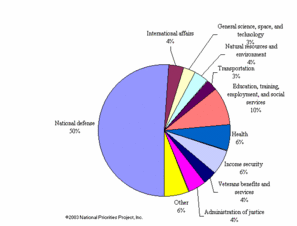
    US federal spending

    Silver and Gold Prices in the German Wiemar Republic

    Hyperinflation: Wiemar, Germany January 1919 to November 1923
    [Expressed in German Marks needed to buy an oz. of ag. or au.]

    Jan. 1919 Silver 12 Gold 170
    May. 1919 Silver 17 Gold 267
    Sept. 1919 Silver 31 Gold 499
    Jan. 1920 Silver 84 Gold 1,340
    May 1920 Silver 60 Gold 966
    Sept. 1921 Silver 80 Gold 2,175
    Jan. 1922 Silver 249 Gold 3,976
    May. 1922 Silver 375 Gold 6,012
    Sept. 1922 Silver 1899 Gold 30,381
    Jan. 1923 Silver 23,277 Gold 372,447
    May. 1923 Silver 44,397 Gold 710,355
    June 5, 1923 Silver 80,953 Gold 1,295,256
    July 3, 1923 Silver 207,239 Gold 3,315,831
    Aug. 7, 1923 Silver 4,273,874 Gold 68,382,000
    Sept. 4, 1923 Silver 16,839,937 Gold 269,429,000
    Oct. 2, 1923 Silver 414,484,000 Gold 6,631,749,000
    Oct. 9, 1923 Silver 1,554,309,000 Gold 24,868,950,000
    Oct. 16, 1923 Silver 5,319,567,000 Gold 84,969,072,000
    Oct. 23, 1923 Silver 7,253,460,000 Gold 1,160,552,662,000
    Oct. 30, 1923 Silver 8,419,200,000 Gold 1,347,070,000,000
    Nov. 5, 1923 Silver 54,375,000,000 Gold 8,700,000,000,000
    Nov. 13, 1923 Silver 108,750,000,000 Gold 17,400,000,000,000
    Nov. 30, 1923 Silver 543,750,000,000 Gold 87,000,000,000,000

    April 25, 2006

    Tehran insider tells of US black ops


    By an Asia Times Online Special Correspondent

    TEHRAN - A former Iranian ambassador and Islamic Republic insider has provided intriguing details to Asia Times Online about US covert operations inside Iran aimed at destabilizing the country and toppling the regime - or preparing for an American attack.

    "The Iranian government knows and is aware of such infiltration. It means that the Iranian government has identified them [the covert operatives] but for some reason does not want to show [this]," said the former diplomat on condition of anonymity.

    Speaking in Tehran, the ex-Foreign Ministry official said the agents being used by the US "were originally Iranians and not Americans" possibly recruited in the United States or through US embassies in Dubai and Ankara. He also warned that such actions will engender "some reactions".

    "Both sides will certainly do something," he said in a reference to Iran's capability to stir trouble up in neighboring Iraq and Afghanistan for the occupying US troops there.

    Veteran US journalist Seymour Hersh wrote in a much-discussed recent article in The New Yorker magazine that the administration of President George W Bush has increased clandestine activities inside Iran and intensified planning for a possible major air attack as the crisis with Iran over its nuclear program escalates.

    Hersh wrote that "teams of American combat troops have been ordered into Iran, under cover, to collect targeting data and to establish contact with anti-government ethnic-minority groups". The template seems identical to the period that preceded US air strikes against the Taliban regime in Afghanistan during which a covert Central Intelligence Agency (CIA) campaign distributed millions of dollars to tribal allies.

    "The Iranian accusations are true," said Richard Sale, intelligence correspondent for United Press International, referring to charges that the US is using the Mujahideen-e Khalq (MEK) organization and other groups to carry out cross-border operations. "But it is being done on such a small scale - a series of pinpricks - it would seem to have no strategic value at all."

    There has been a marked spike in unrest in Kurdistan, Khuzestan and Balochistan, three of Iran's provinces with a high concentration of ethnic Kurdish, Arab and Balochi minorities respectively. With the exception of the immediate post-revolutionary period, when the Kurds rebelled against the central government and were suppressed violently, ethnic minorities have received better treatment, more autonomy and less ethnic discrimination than under the shah.

    "The president hasn't notified the Congress that American troops are operating inside Iran," said Sam Gardiner, a retired US Army colonel who specializes in war-game scenarios. "So it's a very serious question about the constitutional framework under which we are now conducting military operations in Iran."

    Camp Warhorse is the major US military base in the strategic Iraqi province of Diyala that borders Iran. Last month, Asia Times Online asked the US official in charge of all overt and covert operations emanating from there whether the military and the MEK colluded on an operational level. He denied any such knowledge.

    "They have a gated community up there," came the genial reply. "Not really guarded - it's more gated. They bake really good bread," he added, smiling.

    But that is contrary to what Hersh was told by his sources, According to him, US combat troops are already inside Iran and, in the event of air strikes, would be in position to mark critical targets with laser beams to ensure bombing accuracy and excite sectarian tensions between the population and the central government. As of early winter, Hersh's source claims that the units were also working with minority groups in Iran, including the Azeris in the north, the Balochis in the southeast, and the Kurds in the northwest.

    Last week, speaking on the sidelines of a Palestinian solidarity conference, Major-General Yehyia Rahim Safavi, the Iranian Revolutionary Guard Corps (IRGC) commander, sent a warning to the US and British intelligence services he accuses of using Iraq and Kuwait to infiltrate Iran. "I tell them that their agents can be our agents too, and they should not waste their money so casually."

    On April 9, Iran claimed to have shot down an unmanned surveillance plane in the southwestern province of Khuzestan, according to a report in the semi-official Jumhuri Eslami newspaper. US media have also reported that the US military has been secretly flying surveillance drones over Iran since 2004, using radar, video, still photography and air filters to monitor Iranian military formations and track Iran's air-defense system. The US denied having lost a drone.

    This new mission for the combat troops is a product of Defense Secretary Donald Rumsfeld's long-standing interest in expanding the role of the military in covert operations, which was made official policy in the Pentagon's Quadrennial Defense Review, published in February. Such activities, if conducted by CIA operatives, would need a Presidential Finding and would have to be reported to key members of Congress.

    The confirmation that the US is carrying out covert activities inside Iran makes more sense out of a series of suspicious events that have occurred along Iran's borders this year. In early January, a military airplane belonging to Iran's elite Revolutionary Guards went down close to the Iraqi border. The plane was carrying 11 of the Guard's top commanders, including General Ahmad Kazemi, the commander of the IRGC's ground forces, and Brigadier-General Nabiollah Shahmoradi, who was deputy commander for intelligence.

    Although a spokesman blamed bad weather and dilapidated engines for the crash, the private intelligence company Stratfor noted that there are several reasons to suspect foul play, not least of which was that any aircraft carrying so many of Iran's elite military luminaries would undergo "thorough tests for technical issues before flight". Later, Iran's defense minister accused Britain and the US of bringing the plane down through "electronic jamming".

    "Given all intelligence information that we have gathered, we can say that agents of the United States, Britain and Israel are seeking to destabilize Iran through a coordinated plan," Minister of Interior Mustafa Pour-Mohammadi said. This sentiment was echoed on websites such as AmericanIntelligence.us, where one reader commented, "We couldn't have made a better hit on the IRGC's leadership if planned ... sure it was just an accident?"

    Then, in late January, a previously unknown Sunni Muslim group called Jundallah (Soldier of Allah) captured nine Iranian soldiers in the remote badlands of Sistan-Balochistan province that borders Afghanistan and Pakistan. And in mid-February, another airplane crashed just inside Iraq after taking off from Azerbaijan and transiting Iranian airspace. The Iranian Mehr news agency reported that the "passengers on board were possibly of Israeli origin". It added that US troops have restricted access to the site to Iraqi Kurdish officials and that Western media were reporting the passengers aboard as having been German.

    The Iranian government has not sat idly by and just taken these breaches of sovereignty. Early this month, an unidentified source in the Interior Ministry was quoted by the hardline Kayhan newspaper as saying that the leader and 11 members of the Jundallah group had been killed by Iranian troops. Then last Friday, Iranian missile batteries shelled Iranian Kurdish rebel positions inside Iraqi territory. They were targeting a militant group called PJAK that seeks more autonomy for Iran's Kurdish population and has been operating out of Iraq since 1999.

    The former Iranian ambassador argues that in the event that US pressure on Iran continues, "the end of the tunnel" for President Mahmud Ahmadinejad's administration is "weaponization of the [nuclear] technology ... and a military strike".

    "The Americans are pushing Iran to become a nuclear state. Iran just wants to be a supplier of nuclear fuel. But [with their threats] they are pushing it further."

    April 24, 2006

    Statement by G-7 Finance Ministers and Central Bank Governors April 21, 2006


    We, Ministers and Governors, met today and resolutely reaffirmed that openness and globalization are beneficial in promoting economic prosperity and reducing poverty. These benefits are most effectively realized with sound economic management and supportive policies for those whose welfare is adversely affected. We committed to: strengthen economic policies in our countries; work together to remove distortions to the global adjustment process; resist protectionism and promote liberalization of trade and investment including an ambitious outcome from the Doha Development Round; and modernize the international financial institutions.

    The strong global economic expansion continues into its fourth year and the outlook remains favorable, supported by improved macroeconomic policies in many countries as well as benign financial market conditions. Inflation remains contained despite high oil prices and global trade growth is buoyant. Yet risks remain from oil market developments, global imbalances, and growing protectionism. We underscored that global economic adjustment is a shared responsibility.

    We are strengthening the dialogue between oil producers and consumers to further improve market transparency through the release of more complete and timely data on production, consumption and inventories, and for clear reporting of oil reserves. We urge investment in exploration, production, energy infrastructure, and refinery capacity. Investment is crucial and oil producing countries should provide open and secure investment environments to enable market participants to meet pressing needs. We remain committed to greater energy efficiency, conservation, and diversification, which will improve the balance between supply and demand.

    We reaffirm that exchange rates should reflect economic fundamentals. Excess volatility and disorderly movements in exchange rates are undesirable for economic growth. We continue to monitor exchange markets closely and cooperate as appropriate. Greater exchange rate flexibility is desirable in emerging economies with large current account surpluses, especially China, for necessary adjustments to occur.

    We welcomed the IMF Managing Director's Strategic Review to equip the IMF to help countries meet the macroeconomic and financial policy challenges of globalization. We supported the strengthening of IMF surveillance, including through increased emphasis on the consistency of exchange rate policies with domestic policies and a market-based international monetary system and on the spillover effects of domestic policies on other countries. We support a new remit for bilateral and multilateral surveillance by the IMF. An ad hoc quota increase would help better to reflect members' international economic weight. We agreed on the need for comprehensive reform of the IMF, and called on the Managing Director to come forward with concrete proposals for the Annual Meetings in Singapore.

    We reaffirmed the importance of implementing our commitments on development. In that context, we welcomed the decision by the IMF, World Bank, and African Development Bank to implement 100 percent debt cancellation for qualifying countries. We emphasized the importance of avoiding a fresh accumulation of unsustainable debt, of responsible lending by creditors, and of ensuring that recipient countries incur new debt in accordance with the debt sustainability framework. We stressed the need to bolster the fight against corruption so that development assistance effectively promotes growth, and call on the President of the World Bank and other MDB Heads to continue their focus on this issue, bringing forward a strategy in this critical area. Having endorsed the concept of a pilot Advance Market Commitments for vaccines, we call for the additional work necessary to make its launch possible in 2006.

    We reiterated our commitments to combat money laundering and terrorist financing and call on the IMF and the World Bank to collaborate closely with the Financial Action Task Force.

    Finally, we thank Roger Ferguson for his chairmanship of the Financial Stability Forum, and we have asked Mario Draghi to be his successor. ANNEX: GLOBAL IMBALANCES

    We, Ministers and Governors, reviewed a strategy for addressing global imbalances. We recognized that global imbalances are the product of a wide array of macroeconomic and microeconomic forces throughout the world economy that affect public and private sector saving and investment decisions. We reaffirmed our view that the adjustment of global imbalances:

    Is shared responsibility and requires participation by all regions in this global process;

    Will importantly entail the medium-term evolution of private saving and investment across countries as well as counterpart shifts in global capital flows; and

    Is best accomplished in a way that maximizes sustained growth, which requires strengthening policies and removing distortions to the adjustment process.

    In this light, we reaffirmed our commitment to take vigorous action to address imbalances. We agreed that progress has been, and is being, made. The policies listed below not only would be helpful in addressing imbalances, but are more generally important to foster economic growth.

    In the United States, further action is needed to boost national saving by continuing fiscal consolidation, addressing entitlement spending, and raising private saving.

    In Europe, further action is needed to implement structural reforms for labor market, product, and services market flexibility, and to encourage domestic demand led growth.

    In Japan, further action is needed to ensure the recovery with fiscal soundness and long-term growth through structural reforms.

    Others will play a critical role as part of the multilateral adjustment process.

    In emerging Asia, particularly China, greater flexibility in exchange rates is critical to allow necessary appreciations, as is strengthening domestic demand, lessening reliance on export-led growth strategies, and actions to strengthen financial sectors.

    In oil-producing countries, accelerated investment in capacity, increased economic diversification, enhanced exchange rate flexibility in some cases.

    Other current account surplus countries should encourage domestic consumption and investment, increase microeconomic flexibility and improve investment climates.

    We recognized the important contribution that the IMF can make to multilateral surveillance.

    A THOUSAND CLOWNS

    by Bill Bonner

    Economics has been called the "dismal science." But even that is merely fraud and flattery. Economics is dismal, but it isn't science. At its best it is merely voyeurism - peeping in people's windows as they go about their business and trying to figure out what they are doing. At worst, it is pompous theorizing about how to get the schmucks to do better.

    We doubt that you are especially interested in economics, dear reader. We know we are not. But we can't resist a good comedy...or a good opportunity to point and giggle. We keep our eye on economists and politicians the way children watch clowns; we can't wait to see them get whacked in the head or trip over each other.

    But what is amusing is also instructive. Are not clowns people too? Are they not part of human life...human organization...and human economy? Every one of them is driven by the same motors that power everyone else. They want power...glory...money. But how do they get it? Can we not watch politicians and economists and learn something about ourselves?

    One of the many conceits of politicians and economists are that they are somehow out of ordinary. They are godlike, or so they pretend, having no other ambition but to make the world a better place. Neither drink, nor meat, nor false witness cross their lips. They sweat for no material gain...and know no lust - save for the betterment of all mankind. They pass laws...they enact codes and regulations...they jiggle this lever and turn another - as if they were the masters of the whole human race, rather than mere parts of it themselves. Since they float above it all, they are not subject to the normal temptations. The rest of us spend our whole lives like animals - craving profits, mates, status, pride, love, and money like a raccoon searching for a garbage pail without a lid. Unless we are kept in tight cages, who knows what we will do?

    That is why the tabloid press - especially in England - loves the stories of the government ministers having affairs with their secretaries or cheating on their income tax. Who doesn't like to see hypocrisy revealed in public? It is as if the King himself had been caught with his pants down; we gape...and see that he is human, just like the rest of us.

    But thank God there are leaders! Thinkers! Theorists with their "isms" and their rat wire...ready not merely to keep us from hurting one another, but also to give us a sense of moral purpose. It is not enough that we should each seek happiness in our own private way, we must Free the Sudetenland! Abolish Poverty! Make the World Safe for Democracy! We must realize our manifest destiny...and provide liebensraum [living space] for the German people! Full employment! A minimum wage! No humbug left behind!

    We bring this up only to laugh at it.

    In the early 20th century, John Maynard Keynes came up with a new idea about economics. The politicians loved it; Keynes explained how they could meddle in private affairs on a grand scale - and, of course, make things better. Keynes argued that a government could take the edge off a business recession by making more credit available when money got tight...and by spending itself to make up for the lack of spending on the part of consumers and businessmen. Keynes suggested, whimsically, hiding bottles of cash all around town, where boys might find them, spend the money, and revive the economy.

    The new idea caught on. Soon economists were advising all major governments about how to implement the new "ism." It did not seem to bother anyone that the new system was a fraud. Where would this new money come from? And what made anyone think that the economists' judgment of whether it made sense to spend or save was better than individuals? All the Keynesians had done was to substitute their own guesses for the private, personal, economic opinions of millions of ordinary citizens. They had resorted to what Franz Oppenheimer called "political means," instead of allowing normal "economic means" to take their own course.

    The economists wanted what everyone else wants - power, prestige, women (except for Keynes himself, who preferred men). And there are only two ways to get what you want in life, dear reader. There are honest means, and dishonest ones. There are economic means, and there are political means. There is persuasion...and there is force. There are civilized ways...and barbaric ones. The economist is a harmless crank as long as he is just peeping through the window. That is what we do here at The Daily Reckoning. But when he undertakes to get people to do what he wants - either by offering them money that is not his own...by defrauding them with artificially low interest rates...or by printing up money that is not backed by something of real value (such as gold)...he has crossed over the dark side. He has moved to political means to get what he wants. He has become a jackass.

    Keynesian improvements were applied in the '20s - when Fed governor Ben Strong decided to give the economy a little "coup de whiskey" - and later in the '30s when the stockmarket was recovering from the hangover. The results were predictably disastrous. And along came other economists with their own bad ideas. Rare was the man, like Robert Lucas or Murray Rothbard, who pointed out that you could not really improve economic results with political means. If a national assembly could make people rich simply by passing laws, we would all be billionaires, because assemblies have passed a multitude of laws and seem capable of enacting any piece of legislation brought before them. If laws could make people wealthy, some assembly somewhere would have found the magic edicts - simply by chance.

    But instead of making them richer, each law makes them a little poorer. Every time political means are used they interfere with the private, civilized economic arrangements that actually get people what they want. One man makes shoes. Another grows potatoes. The potato grower goes to the cobbler to buy a pair of shoes. He must exchange two sacks of potatoes for one pair of penny loafers. But then the meddlers show up and tell him he must charge three sacks...so that he can pay one in "taxes," to the meddlers themselves. And then he needs to put in an alarm system in his shop, and buy a hardhat, and pay his helper minimum wage, and fill out forms for all manner of laudable purposes. When the potato farmer finally shows up at the cobbler's he is informed that the shoes will cost seven sacks of potatoes! That is just what he has to charge in order to end up with the same two sacks he needed to charge in the beginning. "No thanks," says the potato man, "At that price, I can't afford a pair of shoes."

    What the potato grower needs, say the economists, is more money! The money supply has failed to keep pace, they add. That was why they urged the government to set up the Federal Reserve in the first place; they wanted a stooge currency that would be ready to go along with their plans. Gold is fine, they said, but it's anti-social. It resists new "isms" and drags its feet on financing new social programs. Why, it is positively recalcitrant! Clearly, when we face a war or a Great National Purpose we need money that is willing to stand up and sign on. Gold malingers. Gold hesitates. Gold is reluctant and reticent. Gold is fine as a private money. But what we need is a source of public funding...a flexible, expandable national currency...a political money that we can work with. We need a dollar that is not linked to gold.

    In the many years since the creation of the Federal Reserve system as America's central bank, gold has remained as steadfast and immobile as ever. An ounce of it today buys about the same amount of goods and services as an ounce in 1913. But the dollar has gone along with every bit of political gimcrackery that has come along - the war in Europe, the New Deal, WWII, the Cold War, the Vietnam War, the war on poverty, the war on illiteracy, the New Frontier, the Great Society, Social Security, Medicare, Medicaid, the War in Iraq, the war on terror...the list is long and sordid. As a result, guess how much a dollar is worth today in comparison to one in 1913? Five cents.

    Keynesianism is a fraud. Supply-siderism is a con. The dollar itself is a scam. All were developed by people with good intentions. But these good intentions not only paved the road to Hell, they greased it. There was no point putting on the brakes. Once underway, there was no stopping it.

    Right now, the United States slides towards some sort of Hell. A half-century of deceit has produced a nation that is ready to believe anything...and go along with anything...provided it promises to make them rich. They will be very disappointed when they discover that all the political means they counted on - the phony money, the laws, the regulations, and the wars - have made them poorer. That is when we will really need cages...

    "Nothing in nature is evil," said Marcus Aurelius. Keynes was human. Even Adolf Hitler was a man, a part of nature himself. And the "Evil Empire," was it not created by men too, men who - like economists and politicians - followed their own natural impulses? Adolf may have erred and strayed. But he did so with the best of intentions; he thought he was building a better world. And he had all the "reasons" you could ask for. He could argue all day; "proving" that his plan was the best way forward.

    Not that there weren't arguments on the other side. What were smart people to do? People argued about Keynesianism for many years. Each side had good points. One was convincing; the other was persuasive. It was like a couple arguing in divorce court - the husband forgot to take out the trash and knocked over a vase; the wife ran him over with the family car. "He had it coming," she says.

    What would an observer think? No amount of logic could help him. Both parties made good points. All the judge could do was to fall back on his own deep sense of right and wrong, of proportion...and good taste. "She shouldn't have run him down," he says solomaniacally.

    "Love the man, hate the sin," say the Baptist preachers. They have a useful point. There's no point in hating Adolf, Josef, Ossama...or John Maynard...or any of the other thousands of clowns who entertain, annoy and murder us. They are God's creatures too, just like the rest of us. What they did wrong was what they always do wrong...they all resorted to political means, to get what they wanted.

    We do not hate them; we just hope they get what they deserve.

    Bill Bonner

    The Daily Reckoning

    April 23, 2006

    Special Report: Australia soars on uranium bonanza

    The prospectors of the outback are coining it as nuclear comes back into fashion. By Paul Ham in Sydney
     
     
    AUSTRALIAN uranium miners come from tough stock. Bob Johnson’s great-great-great grandfather was a convict named Tom Askew, transported Down Under in 1819 for stealing 16 ducks to feed his starving family in Lincolnshire.
    “He was a church warden, desperately poor. He got himself a 15-year-old wife, they had six kids, and he ended up becoming a gold prospector,” said Johnson, who looked up his ancestor’s records while working for British Coal in the 1980s.


    Almost 200 years later, Askew’s descendant is also a prospector. But Johnson has joined a very different gold rush: he is looking not for gold but for yellow cake — mining speak for uranium ore. Australia has the world’s largest reserves: 40% of known deposits.

    And suddenly, the world desperately wants Australia’s yellowcake. China has just signed an agreement to buy thousands of tonnes, a deal said to be worth £40 billion. The metal will power the 28 new nuclear reactors it plans to build by 2020.

    The Australian deal was very sensitive. China has not signed the nuclear non-proliferation treaty, and the green lobby fears that enriched uranium may be used to make nuclear weapons. But the Australian government has waved aside those concerns. China, it said, has undertaken to use the uranium exclusively for nuclear power.

    China is in good company. India has announced a big investment in nuclear power, with plans to build 24 reactors. Europe, too, now sees it as a cleaner alternative to burning fossil fuels. Tony Blair’s scientific advisers have endorsed nuclear power. Sweden and France have used it for decades to electrify their countries, with no harmful results; and America has restarted its programme, with plans to build several reactors. Even some militant greens, horrified by the greenhouse gases produced by fossil fuels, have accepted the case for nuclear energy.

    The biggest beneficiaries will be Australian uranium miners, who have been extraordinarily quick to grasp this immense opportunity. Dozens of tiny uranium prospectors with little more than a drill bit between their teeth have floated on the Australian stock exchange in recent months.

    Their share prices have soared as “uranium-mania” has gripped local investors, amid analysts’ warnings of a bubble mentality. The believers point to the solid demand, chiefly Chinese, that underpins the industry — the price of uranium has risen from US$7 (£4) a pound two years ago to US$40 today. Some are steering clear, fearing a repeat of the dotcom fiasco: “The whole junior (explorer) situation has gone completely mad at the moment,” said Gavin Wendt, a resource analyst at Fat Prophets, an Australian share-tipping company.

    But the case for uranium is also underwritten by the imminent exhaustion of supplies of enriched uranium taken from obsolete, chiefly Russian, nuclear weapons, which have until recently met demand in Europe and America.

    The Australian federal government has stoked the euphoria, with explicit support from resources minister Ian Macfarlane, who said this month that local uranium miners could be shipping uranium to Asian countries within four years.

    Two of the world’s biggest mining companies, Australia’s BHP Billiton and Britain’s Rio Tinto, are best placed to exploit this opportunity. BHP Billiton owns the vast Olympic Dam mine in South Australia, which has the world’s largest untapped reserves. Rio Tinto, through its subsidiary Energy Resources Australia (ERA), is Australia’s largest exporter of uranium. It owns the Ranger and Jabiluka mines in the Northern Territory. Both companies’ cashflow has surged in recent years due to the global commodities boom.

    But investors are eyeing pure uranium stocks. They include smaller miners and explorers such as Marathon Resources, Summit Resources, Toro Energy, Paladin Resources and Alliance Resources, whose share prices have sizzled in recent weeks. Toro, which listed on March 23, has risen 504% to about $1.30. Paladin has soared 509% over the past year to about $5.40.

    Pure miners have tended to outdo explorers, because the real money is in extracting and selling the ore. But that hasn’t stopped dozens of minnows lining up to entice investors: Giralia is floating two in coming months: U308 and Gladiator Resources. Investors are queuing up; anything with uranium attached to it tends to be heavily oversubscribed.

    Uranium’s return to global favour has vindicated a few doughty Australian pioneers, mostly hard-bitten geologists, who for decades have stayed the course, dismissed the militant green hysteria about global irradiation, and are now set to become very rich indeed.

    Johnson is one of the hardiest of Australia’s uranium barons. The son of an iron-foundry worker, he is a tough, 58-year-old with degrees in geology and computer science. He invented the Maptek three-dimensional mine-planning software used by mining companies around the world. He is a founding director of Curnamona Energy, which has exploration rights over 4,300 square kilometres of the best uranium “paleo-valley sands” of South Australia.

    Curnamona has been a huge favourite with investors, partly because it uses new technology to detect uranium deposits. It was also well advanced. Floated in April 2005, money has since “just walked through the door”, said Johnson. “We saw this boom coming a couple of years ago. Everyone was negative. We realised there was a lot of uranium in the ground.”

    Curnamona, like Toro Energy, is an explorer — it has no assets, as Johnson readily admits. “We’re a speculative company, but we have a very methodical approach.”

    Like many uranium pioneers, he has little time for militant environmentalists. “The green movement has actually delayed the introduction of a safer alternative to coal. By stigmatising uranium, they have actually damaged the environment,” he said.

    Kate Hobbs is the only woman to head an Australian uranium mining company, Hindmarsh Resources, which floated this year to a thunderous reception. Yet she, too, cheerfully admits that her firm is purely an explorer, with no assets.

    Hindmarsh has a licence to explore 14,500 square kilometres in South Australia. The prospect has already attracted a buyer for the tiny company:

    Canada’s Mega Uranium will take control of Hindmarsh in the coming weeks.

    As a result, Hobbs, a 55-year-old mother of three, will be free to pursue her other mining interests. She has 1.5m share options in Hindmarsh, whose share price is at about $1.60 and rising. She speaks scornfully of the “great disservice” done to the environment by green groups that put the brakes on nuclear power.

    Greg Hall, a mining engineer, is a veteran of the uranium sector, with 27 years’ experience of extracting yellow cake and other minerals from the Australian outback.

    Hall, 47, has felt the sharp end of the environmental attack on uranium — he was mining manager of ERA’s Ranger and Jabiluka uranium mines in the Northern Territory at the height of the protests in the late 1990s and early 2000s. He now smiles at the idea of the green movement supporting nuclear power over fossil fuels.

    Between 1987 and 1992 he was responsible for the development and management of underground operations at Olympic Dam, situated in one of the earth’s most inhospitable regions. “When I first went there I lived in a caravan with my wife,” he said. “It was a bit of a shock for her — she worked in the fashion industry.”

    Last month Hall became managing director of the newly floated Toro Energy, an exploration spin-off from two mining companies, Oxiana Resources and Minotaur Exploration. Toro’s goal is to find uranium in an area covering 26,000 square kilometres in the centre of South Australia.

    Alan Eggers, founding director of Summit Resources, is equally upbeat about the prospects for uranium. A hard man of the mining sector, Eggers has suffered two setbacks in the wake of the collapse of commodities prices — the second time he was halfway through building a new home, with a wife and children.

    Summit is now largely seen as a “Queensland government play”, pinning its mining hopes in Mount Isa to the relaxation of the ban on uranium mining by the Australian Labor party. At present the Labor states of Western Australia and Queensland both ban uranium mining; but that is expected to change at the Labor party conference in April 2007. If so, Summit’s share price will hit the roof.

    Eggers holds a master’s degree with first-class honours in geology, and has staked his career on finding substantial uranium deposits in Mount Isa. Like Kalgoorlie, in Western Australia, Mount Isa is the gritty heartland of Australian mining, where generations of prospectors have made and lost their fortunes.

    In 1990 Eggers staked out an area near Mount Isa which he believed held substantial deposits of uranium; he invested A$5m in drilling. His persistence paid off: Summit announced in the mid-1990s the discovery of 35,000 tonnes of uranium, worth A$4 billion (£1.7 billion): “From my early days of pegging worthless ground we now have A$4 billion of metal,” he said.

    The Summit share price soared on the back of the discovery. Then it came crashing down when, in 1998, the new Queensland Labor government slapped a ban on uranium mining. That wiped A$70m off the company’s value, and infuriated shareholders. “I had a personal stake of $5m that went to nothing.”

    But in the past three years Summit’s price has clawed back, from 5c in 2003, to $1.65 this month, as investors cling to the hope that Summit will be given the green light.

    Eggers is worth millions of dollars on paper but, like most of Australia’s uranium barons, past experience has made him philosophical about whether he will realise it.


    New powers for IMF

    WASHINGTON -- The International Monetary Fund won new powers to

    police the world economy after its 184 member countries endorsed a

    new framework to monitor how the economic policies of one country

    affects others.

    The countries, represented by finance ministers or central bank

    governors, also agreed that some emerging economies needed more say

    in IMF decision-making, and a proposal for ad hoc increases in their

    voting shares could become a reality by the next IMF meetings in

    September.

    "We resolve to make the IMF more fit for purpose in a global economy

    and more able to address challenges that are quite different from

    those of 1945, when the IMF was created," Chancellor Gordon Brown,

    who also chairs the IMF's policy-setting committee, told a news

    conference.

    "The IMF should be more able to address global questions with

    multilateral surveillance," Brown said.

    The International Monetary and Financial Committee, or IMFC, said

    IMF surveillance would focus on spillovers and links between

    countries' economic policies and reaffirm their monetary, fiscal and

    exchange rates frameworks.

    IMF Managing Director Rodrigo Rato will have the authority to bring

    nations together on an ad hoc basis to thrash out any economic

    misalignments based on IMF analyses.

    Officials said this would create a new forum that better reflected

    the rise of Asia in the global economy and could possibly replace

    bodies like the Group of Seven industrial countries, which some say

    can no longer call all the shots.

    One of the problems facing the G7 is that major economic players

    like China are not part of the club.

    Member countries welcomed enhanced IMF monitoring of exchange rates

    that will be extended to include major emerging markets, but several

    remarked they were hesitant about the IMF publishing analyses on

    theoretical fair value currency rates because it was market

    sensitive.

    China, whose tightly managed currency is a concern to the G7, said

    this did not mean the IMF should interfere in how countries manage

    their exchange rates.

    "Fund surveillance should comply with the objective of promoting

    exchange and financial stability and respect the autonomy as to

    exchange rate systems that is granted to all (IMF) members," China's

    Governor Zhou Xiaochuan told the IMF committee.

    Addressing reporters, the IMF's Rato said the committee gave him a

    clear mandate to propose changes to the voting shares, or quotas, of

    some countries by September.

    "I have spoken several times about the need for increases in voting

    power for some countries, including a number of emerging market

    economies, to ensure they have a role in the fund's decision-making

    process that accords with their increased importance in the world

    economy," he said.

    A proposal he submitted to the IMFC would give ad hoc increases to a

    small number of countries like China, South Korea, Mexico and

    Turkey. Other nations that could also possibly qualify include

    Malaysia, Thailand and Singapore.

    But tensions remain between industrial and developing countries over

    how to reallocate voting power beyond initial increases in the

    quotas for some emerging nations.

    The Group of 24 finance ministers for developing countries from

    Asia, Africa and Latin America on Friday called for a more

    comprehensive package with timelines to greater representation,

    fearing changes could stall after any initial increases.

    They said it was "imperative" that a concrete proposal for changes

    be worked out by the next IMF meeting in Singapore in September,

    which should include a new formula to calculate quotas based on

    purchasing power parity of a country and not gross domestic product

    as is currently the case.

    U.S. Treasury Secretary John Snow said on Saturday he would support

    the ad hoc increase "if it is credibly linked as a down payment on

    near-term fundamental reform," like those to increase the fund's

    watchdog role on currency issues.

    Although it is generally recognised that China's quotas do not

    properly reflect its global economic weight, an increase in its

    voting share may be controversial in light of proposed U.S.

    legislation threatening a veto of such a move in the absence of

    Chinese currency reforms.

    German Finance Minister Peer Steinbrueck called for "equal

    treatment," saying some European countries -- like Germany -- were

    also underrepresented according to quota calculations.

    According to calculations of the current quota system countries like

    Britain, Ireland, Spain, the Netherlands, and Sweden are also

    underrepresented.

    Soros


    --------
    "As the issuer of the world's reserve currency, the U.S. economy has for decades enjoyed the capacity to inflate dollar denominated securities at will. Our competitive advantage in issuing top-rated and liquid securities has served us especially well over the past decade. It was a key facet of “reliquefications” and “reflations” during periods of economic weakness and/or fledgling financial crisis. The much trumpeted “resiliency” of the U.S. economy and banking system owes almost everything to the capacity for the U.S. government and financial sector to endlessly create debt instruments readily accumulated by domestic and foreign holders. And I believe a strong case can be made today that long-term yields would be significantly higher if it weren't for the perception that the Bernanke Fed will aggressively cut rates at the first indication that the U.S. economic Bubble and/or Global Asset Market Bubble are beginning to falter. The blundering Fed apparently not only believes that the U.S. economy is more resilient than in the past, it presumes it now has significant leeway to cut rates and “reflate” when necessary.


    But the financial world is changing rapidly and radically. The dollar is methodically losing its status as a stable and reliable reserve currency. At the same time, currencies generally are losing favor to real assets as store of value. Understandably, market participants are questioning the will and capacity for central bankers and policymakers to stabilize the Unwieldy Global Credit system. It would at this point require a determined and concerted effort to instigate some serious financial and economic restraint, especially among American, Chinese and Japanese authorities. No one would dare hold their breath waiting for this outcome.

    With faith in the prospects for the dollar and global currencies in retreat, the U.S. is in the process of losing its invaluable competitive advantage issuing top-rated liquid securities. This has huge ramifications come the next period of financial dislocation. The Fed's intent to aggressively cut rates and incite yet another bout of lending and leveraged speculation (Credit Inflation) will likely be obstructed by the unwillingness of foreigners to accumulate more dollar IOUs. In the meantime, I believe the changing global landscape will necessitate that that the U.S. now pays an ongoing significant yield differential. Rampant liquidity and speculative excesses demand that global rates rise across the board, while the stability of the dollar depends upon the Fed's willingness to maintain significant rate differentials. Our foreign creditors will demand higher rates and much tighter monetary conditions, and the Fed's dream of wrapping things up before it gets painful faces the reality that our creditors are increasingly tired of getting hurt.

    This week, markets began to demonstrate many of the characteristics one would expect when approaching a key inflection point. There was heightened volatility, spectacular short-squeezes, and palpable euphoria. But there are also indications that the “smart money” is increasingly nervous and beginning to lighten up on some positions (including our currency). It is amazing how many have completely bought into The Notion of a Golden Age of Permanent Global Prosperity; that the omnipotent Fed has everything completely under control; and that surging energy and commodity prices are a sign of how wonderfully healthy the global economy is these day (ignoring that we are instead immersed in history's greatest Credit and Asset Bubbles). One should now be on guard for that exacting oscillation between “gee, things are just marvelously splendid” and the “oh my god, the end is near” – The Unpredictable Greed and Fear Seesaw – that will embroil global markets in an extraordinary period of uncertainty and volatility.

    April 20, 2006

    The Best little mining company in the world: Oxiana

    Listen and weep if you don't have exposure...

    AN EVASIVE RECOVERY

    by Dr. Kurt Richebächer

    In the early 2000s, Mr. Greenspan earned himself the honorable title of "serial bubble blower." Fearful of a painful burst of the equity bubble, he aided and abetted a bond bubble in order to boost the housing bubble. Measured by the mildest postwar recession, it appeared a smashing success. But taking measure of the following anemic recovery, and particularly the following dismal employment and income performance, into account, it was an utter policy failure.

    Any assessment has to further take into account that the government and Federal Reserve have supported this recovery with unprecedented fiscal and monetary lavishness. Tax cuts reduced government revenue by $870 billion, while the Federal Reserve slashed its fed funds rate to 1%, its lowest level since the Great Depression.

    The decisive failures of these policies have been in business fixed investment and in employment, both displaying a drastic shortfall in relation to reported GDP growth.

    Historical experience and economic theory leave no doubt that business fixed investment and employment play the crucial role in providing economic growth with the necessary traction to become self-sustaining. Even in its fifth year, the present U.S. economic recovery remains fully dependent on the housing bubble to drive the consumption bubble.

    The same, by the way, applies more or less to all Anglo-Saxon countries. Over the past few years, all of them have hung on the steroid of inflating house prices providing the collateral for outsized consumer borrowing-and-spending binges. Their further common features are large budget deficits (except Australia), very low savings and large trade deficits (except Canada).

    All of these economies have, in essence, become bubble economies. This means that monetary policy impacts the economy primarily through inflating asset prices, which in turn stimulate and facilitate credit-financed consumer spending.

    An important adverse feature of all asset and credit bubbles is that they inherently break an economy's pattern of growth. In all the English-speaking countries, the credit excesses have primarily inflated house prices. Using these as rising collateral, consumers have enjoyed unprecedented borrowing facilities to spend as never before in excess of their current income. What resulted were extremely unbalanced economies.

    Distorted demand over time invariably also distorts the economy's supply side. What has actually happened in all these countries is that domestic spending has increasingly outpaced domestic output. On the other hand, low domestic saving and capital investment keep a brake on output growth. The infallible result in all these countries, except Canada, is large, chronic trade deficits. Evidently, all this is structural, not cyclical.

    Essentially, the low savings, the low capital investment and the soaring trade deficits act as major drags on economic growth. Over the past few years, these drags have been offset by the rampant demand creation through the housing bubbles. But the trouble with this recipe is that it worsens the structural distortions and imbalances.

    Nevertheless, all asset and credit bubbles eventually run out of steam. Plainly, this is going on in all these bubble economies, the United States included. For us, the key question about whether there will be a hard or soft landing is the extent of the prior excesses. They are the worst in history.

    The consensus sees new momentum in the U.S. economy from strong retail sales. We focus on the inflation-adjusted monthly figures for overall consumer outlays and observe the opposite. There are sharp fluctuations in spending on durables, but with a distinct downward trend.

    As everybody knows, or ought to know, the strong monthly changes in consumer spending have their main cause in the sharp ups and downs of auto promotions. In the quarterly GDP reports, they are even annualized. But comparing the above figures, it strikes the eye that the recovery in the last three months was very much weaker than in the prior downturn.

    Any assessment of the U.S. economy's further course has to start with the recognition that the housing bubble is doomed, and in its wake the consumption bubble. Only the vigor of their slowdown is in question. Given this virtual certainty, the U.S. economy urgently needs an alternative source of growth.

    Unfortunately, there is but one possible alternative source, and that is sharply rising business fixed investment and exports. The consensus, apparently, takes a strong revival of business fixed investment for granted.

    Assessing the relevant figures, including profits, we take for granted that business investment and hiring are going to fail in the future even more than in the past. First of all, the record-sized fiscal and monetary stimulus of all times has been exhausted; second, business fixed investment in the United States, even though heavily bloated by hedonic pricing of computers, recently accounts for a record low of 11.5% of GDP, as against more than 70% for consumer spending; third, consumer demand is weakening; and fourth, nonresidential investment has slumped from double-digit growth rates in 2004 to just 2.6% in the fourth quarter of 2005, after 10% in the first half.

    Common arguments in favor of a comeback of capital investment are high business liquidity and high profits. Plainly, they have recovered from their lows, but growth has sharply slowed from 2004, when tax incentives gave a strong impetus.

    New orders for machinery are up over the year, but by far not enough to suggest a developing investment boom. Given for many years a preponderance of short-lived investments, it needs moreover large and ever-higher capital investments just to replace worn-out plant and equipment, as reflected in rising depreciations. There is every reason to assume that the rise in new orders of capital goods barely reflects rising depreciations.

    Most impressive is definitely the following chart reflecting the U.S. economy's profit performance. Since 2000, it is the greatest profit boom in the whole postwar period. Strikingly, it even compares most favorably with the profit performance during the "New Paradigm" boom years, from 1995-2000.

    Profits of the whole nonfinancial sector were $401 billion in 1995 and $413.4 billion in 2000. But from 2001 to late 2005, they have almost trebled, from $322 billion to $868.5 billion. Wall Street, of course, eagerly seizes them. For us, these numbers are so absurd as to require investigation.

    First of all, it was an extremely imbalanced profit boom reflecting an extremely imbalanced economic recovery. This recovery had literally nothing in common with the business cycle pattern of the past. Intrinsically, this shows in a radically divergent profit pattern.

    The profit boom of the last few years was narrowly centered in the category "other." The fact is that the housing bubble has been crucial not only in creating demand and GDP growth, but also in creating employment and profits.

    Most astonishing is, of course, the steep jump in profits from $534.2 billion in 2004 to $863.3 billion in 2005. Two phony causes are easily identified. One is a sharp decline in depreciations, from $804.3 billion to $668 billion. Depreciations are a business expense, of course. If a firm stops investment, it increases its profits. But this is hardly a desirable way toward higher profits. The second major cause of the sudden profit surge was a tax incentive that induced companies to repatriate a large amount of foreign profits into domestic profits.

    Leaving aside the grossly distorted profit figures for 2005, we focus on the period from 1997-2004, the former marking the U.S. economy's prior profit peak in the postwar period. Over these seven years, including the "New Paradigm" boom years, overall profits barely rose.

    The next thing to recognize is the tremendous differences in profit performance between sectors. For all sectors producing or moving goods, manufacturing and transportation, it has been seven years of profit disaster, and moreover of steady deterioration.

    In contrast, it has been seven years of profit bonanza for retail trade, wholesale trade and in particular for the branches captured under "Other." Here construction and real estate agents have been the main contributors.


    We would say that overall this is a dismal profit performance, definitely giving no reason for a booming stock market. Measured against nominal GDP, which has risen 41% between 1997-2004, it is a profit collapse.

    Very poor profits in the aggregate are the one big problem. An extremely lopsided pattern between sectors is the other. Manifestly, this lopsidedness in the profit pattern perfectly reflects the extraordinary lopsidedness of the U.S. economy's growth pattern during these years. The housing and consumption bubbles rule.

    It always amuses us when Mr. Greenspan and Mr. Bernanke criticize the government for its budget deficits. The irony is that the chronic deficit spending by the consumer, induced by their monetary looseness, is doing far greater structural damage to the economy.

    Regards,

    Dr. Kurt Richebächer

    for The Daily Reckoning