Main

May 23, 2006

The return of fear to world stock markets


>Published: May 20 2006 03:00 | Last updated: May 20 2006 03:00
>>

Like a sudden storm on a clear day, the tempest that swept through the world's stock markets over the course of the past 10 days caught many investors by surprise. That storm abated yesterday but left the markets battered in its wake. Since peaking in late April/early May the FTSE 100 index has fallen 7.5 per cent, the S&P 500 4.6 per cent, the Eurotop 7.1 per cent and the Nikkei 225 8 per cent. During the three-year-long bull market that began in March 2003, there have been other corrections, all of which were short-lived. But this one may turn out to be more significant.

Even after the recent declines, world stock markets remain far above their 2003 lows. The FTSE 100 index is up 73 per cent, the S&P 500 58 per cent, the Eurotop 91 per cent and the Nikkei 112 per cent. It is too soon to say the bull market is over. However, the latest sell-off reflects changes in global conditions that will make further equity gains much more challenging.

One dramatic change is the increase in volatility. The Chicago Board Options Exchange VIX index, which measures market expectations of volatility, jumped from 11.83 on May 1 to a year-high of 17.31 in trading yesterday. While volatility is important in its own right, this jump reflects deeperconcerns.

The market is gripped by two scares: an inflation scare and a dollar scare. One of the most widely used measures of US inflation expectations, the spread between nominal and inflation-protected government bonds, has risen from 2.34 per cent on January 1 to 2.66 per cent yesterday. Rightly or wrongly, the credibility of the Federal Reserve under its new chairman, Ben Bernanke, is being openly questioned.

Meanwhile, equity investors have taken fright at the fall in the dollar since early April. The dollar recovered some ground this week, on expectations that inflation concerns would force the Fed to raise US interest rates further. But it remains down 3 per cent on a trade-weighted basis since April 1.

Of the two scares, investors should worry less about US inflation and more about the dollar (though the two are obviously related). All new Fed chairmen are tested by the markets. Mr Bernanke is no inflation dove, core inflation on the Fed's preferred measure is still only 2 per cent and the US economy is slowing towards trend.

The dollar is a bigger concern. While a steady and broad-based decline of the kind seen in late April/early May is both necessary and desirable, it could give way to a dollar rout and higher US interest rates. Much depends on Asian central banks, whose intervention to support fixed exchange rates frustrated a decline in the dollar in the post-dotcom bubble period, and their counterparts in oil exporting countries.

In valuation terms, the case for equities also looks weaker than it did a year ago. The rise in long term interest rates (from 4.4 per cent at the start of the year to 5.2 per cent in the US) means shares no longer look as cheap as they did relative to bonds. The yen "carry trade" (borrowing in yen at low interest rates and investing in higher yielding assets), which helped boost all risky assets, is fading away as Japan's economy revives.

If there is no cause for panic, then, there is cause for caution. Investors should expect more volatility ahead. With risk premia still very low by historic standards, there is little scope for outperformance by high-risk assets. If either the inflation scare or the dollar scare prove correct, shares could have a long way further to fall.

May 22, 2006

More on the relative abundance of Gold and Silver


David Zurbuchen submits:

Silver is rarer than gold. Period. There is less silver in the world, above ground than there is gold. That is easy to document. Since I have been harping on this point, no one has been able to refute it.


Even though there are five ounces of gold in the world now for every one ounce of silver, this 5 to 1 ratio will expand as newly mined gold is added to above ground supplies… This should get your juices flowing. It should drive you to buy silver… Silver is more rare than gold, and rarer still is someone who knows this fact. You should act accordingly.

-Ted Butler

Where has Ted Butler so easily documented his claim that silver is more rare than gold? I don’t recall ever reading his proof text. If one does happen to exist, I would appreciate someone sending it to me.

As far as I know, Ted Butler is dead wrong in all of his above pronouncements. It was comments like those above that mislead me into writing my first ever Gold-Eagle essay entitled “Silver: A Rare Opportunity”, an essay which emphasized the very ‘facts’ that I’m now attempting to refute.

Now, I realize I’ll probably be making some enemies by calling Ted Butler a liar, but I believe this is an important issue to come to terms with. If our investment decisions are founded upon fictions, then we are prone to failure. That being said, I do truly enjoy Ted’s writings, after all, he was one of the few writers who really piqued my interest in silver over the years. But nevertheless, I don’t want the average person to be misled by the above claims he has frequently made.

So here are my opposing claims:

1.Silver is not rarer than Gold.

2.The gold to silver rarity ratio is about 1 to 5, not 5 to 1.

3.Finally, there is nothing factual about the statement that silver is rarer than gold, UNLESS you qualify it with the condition that you are only referring to market accessible silver in the form of bullion.

But this is an unfair comparison, because you are including all gold in jewelry form while excluding all silver in jewelry, sterlingware, and privately held bullion/coin forms. Granted, the market price of silver will need to rise a greater percentage than the market price of gold before either its jewelry, silverware, or privately hoarded coin forms become available to the market in large quantities, but the fact still remains that this form of silver is available at some price*.

(We’ll deal more with this ‘price’ in an upcoming essay. For now one would be advised to read “Hidden Silver About to Surface?” But a word of caution, at this time I believe Gene Arensberg’s estimate of how much silver is held in private hoards, if only dealing with silver in coin and bullion form, is too high.)

The Real Silver Deficit

Let us begin by reading a very telling quote from pg. 1046 of the 1954 Minerals Yearbook:

According to the Bureau of the Mint, the world output of silver from 1493 through 1954 was 20,039,4621 troy ounces, valued at $17,278,499,800. Of this total yield, North America produced 62 percent and South America 20 percent. Mexico contributed 35 percent of the total, the United States , Bolivia 9, Peru 9, and Canada 4. It has been estimated that about one-third of the total world production of silver is in circulation as coinage or held by governments for monetary purposes; one-third, including that hoarded, is privately owned; and one-third has been misplaced or dissipated.

Since silver mine production from 3000BC to-1492AD was equal to about 7.6B ounces (Part 1), we must add to this the 20.0B ounces mined from 1492-1954 to arrive at a total of 27.6B ounces of worldwide silver production from 3000BC to 1954AD.

If only two-thirds of those 27.6B ounces remained, then in 1954 there were roughly 18.4B ounces of silver in existence, mostly in the form of coinage, government bullion, private bullion, jewelry, and silverware/sterlingware.

From the following information we can begin to determine the world’s silver supply/demand deficit for the period 1955-2005:

- Worldwide mine production from 1955-2005 was about 19.5B ounces.
- Free-World industrial demand (I.D.) from 1955-2005 was 19.4B ounces.
- I.D. from transitional economies from 1955-2005 is estimated at 3.7B ounces.

(Transitional Economies supplied roughly 16% of the mine supply during this period, so I will also assume that they contributed 16% of the overall industrial demand.)

- I.D from ‘other countries’ from 1977-2005 is estimated at 0.378B ounces.

(Assumes that of the total industrial and arts demand of 630.2M ounces, 60% was used in industrial applications. Data for the period 1955-1976 is missing, but this is relatively insignificant.)

From the above, we discover that the aggregate world demand for the period 1955-2005 was 23.48B ounces (19.4B + 3.7B + .378B = 23.48B ounces)/

If we subtract this number from the cumulative mine supply during this same period (19.5B ounces), we are left with a massive deficit of 3.98B ounces.

(Interestingly enough, in 1941 the total world monetary stocks of silver were about 4.5B ounces (see: Minerals Yearbook 1941 pp. 55-56). When considering that the above deficit of 3.98B ounces does not account for the period of 1942-1954, it becomes crystal clear that there is very little cheap silver remaining.)

But we have yet to factor in old scrap supply, which CPM Group, in their 2003 Silver Survey, defines as:

Scrapped fabricated objects, old coins, old jewelry, decorative objects, household objects, a host of industrial waste, spent ethylene oxide catalysts, old electronic scrap, old sterlingware, old silverware and finally, photographic chemicals, films, and papers [emphasis mine].

Since the vast majority of old scrap supply has come from spent photographic materials (est. 80% in 2000) and catalysts (est. 10% in 2000) [see: http://pubs.usgs.gov/circ/c1196n/], we will assume that 90% of the old scrap that comes to market had its origin in industry as opposed to the arts (i.e. jewelry, sterlingware, decorative objects, etc.). We will then subtract this additional supply from the deficit to arrive at an accurate estimate of how much silver remains.

- Estimated scrap supply from 1955-2005 was 5.45B ounces though due to a deficiency of old scrap supply data for the years 1955-1959, some approximations had to be made based upon known ratios of industrial demand vs. old scrap supply in the neighboring years.

Since we are assuming that 90% of the old scrap came from industrial sources we have:

(-3.98B ounce deficit) + (5.45B ounce scrap supply x 0.90) = 1.47B ounce surplus for the period 1955-2005.

One other factor to consider is a loss of silver content in coinage due to abrasion. For the years 1955-2005, coinage demand was 2.73B ounces. Since the vast majority of this demand was realized between 1955 and 1970 (1.83B ounces worth), I will assume that the loss due to abrasion was 15% of the total in the ensuing 35 years.

- 1.83B x 0.15 = 0.27B ounces lost to abrasion of the coinage.

I’m confident this estimate is conservative for the following reasons:

1. Obviously these newly minted coins were not the only coins in existence during this period, and if we were to include all the coinage that was undergoing abrasion, the above 15% figure would shrink relative to the context of what it described (e.g. 15% loss due to abrasion of 1B ounces worth of coinage is only 7.5% loss due to abrasion of 2B ounces worth of coinage).

2. Large amounts of coins were melted down in the late 1970s, contributing considerably to the surge in old scrap supply during those years. Therefore, my previous assumption that 90% of old scrap had its origin in industrial recycling is probably over-estimated by at least 10-30% during the period 1975-1981, since all of those coins that were melted down would have in effect undergone a 100% loss due to abrasion while simultaneously contributing to the overall old scrap supply.

3. I’m assuming that the other 900M ounces of silver coinage minted between 1971 and 2005 underwent no abrasion at all.

For reasons that I will expound upon in a future essay dealing with the topic of abrasion prior to the 20th century, I feel that the above estimate of silver lost to abrasion should be several orders of magnitude higher. But for the sake of conservatism, I will work with the above number of 0.27B ounces.

•1.47B ounce surplus - 0.27B ounces lost due to abrasion = 1.2B ounce surplus for the years 1955-2005.

Thus, at year-end 1954 we begin with 18.4B ounces of silver existing in all forms, and through the period 1955-2005 which witnessed the rise of the electronic age, it appears we only increased the overall supply of silver by 1.2B ounces, even though we mined almost 20B ounces from the ground! This leaves us with a total of just 19.6B ounces of silver left in existence!

Now, there will likely be some misgivings about the weight I have attributed to the statement from the 1954 Minerals Yearbook, which said, “one-third [of total silver production] has been misplaced or dissipated.”

One might well wonder what exactly is meant by ‘misplaced’?

In order to error towards overstating the amount of silver that remains, so as to avoid as much skepticism as possible, let us assume that 20% of the misplaced silver referred to in the Minerals Yearbook dated 1954 has since been found. This would then leave us with 7.36B ounces of ‘lost’ silver during the period 3000BC-1954AD, instead of the previously stated 9.2 billion ounce loss. All in all, this has the effect of raising the amount of silver left in existence by 1.84B ounces. Thus, our conservative total now stands at 19.6B+1.84B = 21.44B ounces.

Now to compare our findings with those of the CRA Report published in 1992.

From the CRA Report
(Year-end 1991)

CRA estimates that from 1921 through 1990, 10 billion ounces were irrecoverably lost in North America alone, and 12.6 billion ounces for the entire world.

Note: The above estimate is fairly close to the one made in the 1954 Minerals Yearbook.

Before evaluating the CRA Report’s findings, let’s make use of the above statement to make one more estimate of how much silver remains.

1. According to my data, the world produced a total of 45.38B ounces of silver from 3000BC-2005AD.

45.38B -12.6B (silver “irrecoverably lost in North America”) = 32.78B ounces of silver left in existence when accounting for silver lost during the period 1921-1990.

2. From 3000BC to 1920 the world produced about 22.17B ounces, and of this total I estimate that 25% was lost to abrasion (vast majority), shipwreck, or even buried as treasure (including silver buried in tombs).

32.78B – (22.17B x 0.25) = 27.24B ounces of silver left in existence when accounting for silver lost during the period 3000BC –1990AD.

3. From 1991-2005, the world’s industrial demand for silver was 8.63B ounces.
During this same period the world supplied only 2.5B ounces of old scrap.
Assuming that 90% of the old scrap had its origin in recycled industrial materials as before, we are left with:

27.24B ounces – (8.63B – (2.5B x 0.90)) = 20.86B ounces of silver left in existence when accounting for all the silver lost from 3000BC – 2005AD.

This number varies by less than 3% of our previous 21.44B ounce estimate.

Back to the CRA Report and what it had to say about how much silver remained in 1992:

- Total Silver that remains above-ground (all forms): 19.06 billion ounces
- Total Silver contained in silverware and art forms: 16.48 billion ounces
- Total Silver contained in bullion form: 1.40 billion ounces
- Total Silver contained in coin and medallion form: 1.18 billion ounces

Updating the CRA Numbers

During the period 1992-1994: World mine production of silver totaled 1.373 billion ounces (Minerals Yearbooks).

During the period 1995-2004: World mine production of silver totaled 5.639 billion ounces (The Silver Institute).

During 2005 (Partial): World mine production of silver in 2005 totaled 527.3 million ounces (CPM Group – Silver Survey 2005).

Total World Mine Production from 1992 to 2005 = 7.54 billion ounces

Combining this number with the CRA Report’s estimated total above-ground supply of 19.06 billion ounces, we arrive at 26.6 billion ounces of silver remaining above ground.

Since 1992, the world has used nearly 8.1B ounces of silver industrially, but has only returned 2.4B ounces as old scrap. Assuming that 90% of the old scrap had its origin in recycled industrial materials, this leaves us with a total of just 20.66B ounces [26.6 – (8.1B – (2.4 x 0.90)] remaining above ground.

This number is strikingly similar to our 2 other separate findings of 21.44B ounces and 20.86B ounces.

By taking the average of all three, we arrive at 20.99B ounces of silver remaining in the world in all forms (mostly jewelry and silverware).

But in order to temper our enthusiasm in discovering what would actually be a relative rarity ratio between gold and silver of less than 1 to 5 based upon the above numbers, let us further assume that a maximum of 4 billion ounces of silver could be recycled from existing industrial (not including jewelry or sterlingware) materials if the price were right (say $50-$100/ounce). Including this additional potential supply, 24.99B ounces of silver would remain in all forms.

Here then is our new gold to silver ratio based solely upon relative rarity, buffered for the sake of being conservative with that extra 4 billion ounces. Again, I hope the inclusion of this additional 4 billion ounces will be a more than sufficient compromise to account for my inevitable bias towards silver.

The new gold to silver ratio is 24.99 billion ounces Ag/ 4.25 billion ounces Au (see Part 1)/ = 1 to 5.88 (Gold vs. Silver)

This means that based solely upon relative abundance, silver should be trading at about $110.50/ounce (using a gold price of $650.0).

Patience, it seems, is destined to pay some incredible dividends.

Conclusion

Clearly, silver is not more rare than gold, but a 1 to 5.78 rarity ratio is indicative of the incredible leverage to be found in all silver related investments since the current ratio stands at roughly 1 to 54. Will it ever reach the ‘magical’ 1 to 5 ratio insisted upon by Bunker Hunt over 30 years ago? That remains to be seen. But at least now we know for certain that such an idea isn’t nearly as far-fetched as it might have otherwise seemed.

Sources, Updates, and Validation

Sources for calculations in this article:

1. CPM Group’s Silver Survey 2003 & 2005 (www.cpmgroup.com)
2. US Geological Survey (USGS)
3. http://minerals.usgs.gov/ds/2005/140/
4. http://pubs.usgs.gov/of/2004/1251/2004-1251.pdf
5. http://minerals.usgs.gov/minerals/pubs/commodity/silver/
6. Minerals Yearbooks 1932-2004
7. The Silver Institute (www.silverinstitute.org)
8. Stocks of Silver Around the World (Charles River Associates, 1992)

Further Validation of the 60+ Year Structural Silver Deficit

Since 1946 the industrialized nations [i.e. the free-world] of the world have consumed more silver than they have mined, to meet growing demand…

-Sarnoff, Paul. Silver Bulls: The Great Silver Boom and Bust. Connecticut: Arlington House Publishers, 1980 (p.3).

A New Data Point for “The World’s Cumulative Silver Production”

Total Silver mined from 4000 B.C. through 1991: 37.5 billion ounces.

Source: Blanchard, James. Silver Bonanza: How to Profit from the Coming Bull Market in Silver. New York: Simon and Schuster, 1993.

Since mine production from 1992 to 2004 was about 7.0 billion ounces (Part 1), the new total is 37.5 billion ounces + 7.0 billion ounces = 44.5 billion ounces

Previously, the average cumulative silver production based upon 5 sources was 45.55 billion ounces.

With this additional data point, the world’s cumulative silver production is now the even more certain figure of 45.38 billion ounces.

This post is part of a multiple essay series

May 21, 2006

Stagflationary Recession underway in US

The 2005 to 2007 inflationary recession has moved well beyond stagflation. Circumstances deteriorated markedly in the last month, and market perceptions of same have begun to surface, as exhibited by strong gold and a weak dollar. Moreover, the trouble is not confined to a weak economy and higher inflation. It also includes a foundering administration and increasing odds of a shift of power coming out of November's election.

"Signs that the economy is not doing too well abound. Housing starts appear ready to signal recession, and the housing sector has been one of very few bright spots in economic activity over the last six years or so. Aside from politically-gimmicked GDP reporting, most numbers, net of inflation, have been soft to down over the last month, including retail sales, purchasing managers new orders, help wanted advertising, narrow money growth, real earnings, consumer sentiment and even the employment report. Exceptions have included strong industrial production, volatile new orders for durable goods and an improved but still staggering trade deficit.

"Although purposely suppressed in the 'official' data (PPI and CPI), there is an inflation problem. It is driven by oil, and increasingly, it also is being driven by dollar woes. These are factors separate from strong economic activity that commonly is viewed as the source of inflation.

"In like manner, Fed tightening -- designed in theory to slow the economy in order to slow inflation -- will do little to cool the current problem, shy of Volckerish rate hikes aimed at triggering such a severe downturn that prices are pulled down along with business activity into a depression. Quite to the contrary, current Fed activity has been the reverse of the jawboned inflation fighting, aimed at stimulating liquidity, not killing it. While short-term interest rates have been increased, broad money growth also has been soaring, at least prior to its reporting cut-off. Excessive money growth tends to be an inflation stimulant, not a retardant.

"In general, the broad economic outlook has not changed. The 2005 to 2007 inflationary recession continues to deepen. Recession, inflation and risks of heavy dollar selling are upon us, gaining greater market credence, and they continue to offer a nightmarish environment for somewhat less Pollyannaish financial markets than were in place last month.

"The Shadow Government Statistics' Early Warning System (EWS) was activated in May 2005 and signaled the onset of a formal recession in July 2005. The EWS looks at historical growth patterns of key leading economic indicators in advance of major economic booms and busts and sets growth trigger points that generate warnings of major upturns or downturns when predetermined growth limits are breached. Since the beginning of 2005 a number of key indicators have been nearing or at their fail-safe points, with four indicators moving beyond those levels, signaling a recession. Once beyond their fail-safe points, these indicators have never sent out false alarms, either for an economic boom or bust. Housing starts appears ready to generate such a signal in the next month or so.

"With a resumed economic boom massaged into first-quarter GDP reporting, negative GDP growth is not likely to surface in regular government reporting until after the November 2006 election, given the rampant political manipulation of most key numbers. The National Bureau of Economic Research (NBER) should time the downturn to mid-2005 and announce same also sometime after the election, so as not to be deemed politically motivated in its timing.

"Whether or not there is a recession will be a hot topic in the popular financial media, with politics helping to fuel the debate as the election nears. Those Wall Street economists who act as shills for the market will keep up their 'strong growth is just around the corner' hype regardless of any and all evidence to the contrary."

May 20, 2006

Unusual wave of derivatives activity...

May 19 – Financial Times (Gillian Tett ):  “The recent sharp falls in stock markets appear to have been exacerbated by an unusual wave of derivatives activity on the part of hedge funds and big banks, traders yesterday indicated. In particular, some banks and big investors appear to have been forced into selling large amounts of equity futures because they have been acting as counter-parties to large, leveraged bets on the direction of stock market volatility in recent months - and these bets are now unravelling because volatility has increased sharply.  This forced selling has hurt equity futures index prices on markets such as the London International Futures Exchange - and depressed the value of cash equities as well, some observers suggest.  ‘This is an incredibly sensitive topic but it looks as if some big investors are being forced into big moves because they need to hedge these [derivatives] positions,’ one senior trader said yesterday.  It is impossible to track this type of derivatives trading with accuracy, since the investors and banks engaged in these markets are extremely anxious to keep their positions private.”

May 18, 2006

Longer Bull Run = Bigger bubble: Marc Faber


Moneycontrol.com | May 10, 2006


Born in Zurich, Switzerland Mark Faber got his PhD in Economics by age 25. He has worked in all the major money centres of the world from New York to Hong Kong. CNBC-TV18 caught up with investing guru Marc Faber. Excerpts from an interview:

When you were growing up, you were a surgeon's son -- what propelled you to study economics?

Actually at that time I was skiing for the Swiss national team and I did not really know what to study, but I knew that Economics was a relatively easy thing to do. It took only four years.

What did they teach you - what was the world like in the 1960's - and how has your worldview changed through the lenses as an economist?

I think in the 1960s the world had far fewer opportunities; we still had the cold war, the Vietnam War was on and as an investor one couldn't invest in countries like China or India or Taiwan or Indonesia. So the world was much more limited in terms of investment opportunities and even the total credit take -- 3:32 was much lower as a per cent of the economy than it is today.

In other words, that time people had relatively high incomes but the asset values were relatively low. Today in real terms, in the western world, people have relatively low incomes and asset values are high measured by the Dow Jones or by housing prices.

How was the first impact of Asia on you? Being a disciplined Swiss -- was it chaotic, disorganised?

No, not really. I arrived in Hong Kong in the 1970 and Hong Kong Chinese were very hardworking but of course what strikes me today is, how poor Asia was in 1973; if one went to Taiwan, Korea or Singapore, these were very poor societies and if one looks back at the last 30 years -- the progress that has been achieved is just mind boggling.

All I can say is that history is accelerating in terms of speed of change. If one looks at how Bangalore has developed in the last 10 years or how Shanghai has developed in 10-20 years time, there will be changes in the world and in Asia that nobody can really comprehend today.

At that time steel and shipyards were the talk of Asia?

Yes, shipping was a big thing in the 70s. Everybody was building steel plants and cement but in the 1970s, very few people were interested in investing in Asia. Some American institutions had few investments in Japanese stocks (like the Templetons of the world) but aside form British institutions that bought some shares in Malaysia, Hong Kong and Singapore, there were practically no funds of flows out of America and Europe into Asia.

All the flow that time was from Asia into US stocks and also into gold, silver and other precious metals. Then in the late '80s the flow began into Asia from the western world.

There are great myths built about the market and you spent the better part of your life adding to the truths and destroying the myths - one of the great myths is that stock market always goes up in the long run?

That is very difficult to tell. One could argue that in the long run most things will appreciate in value, but the problem is that most companies live only 30 years and then they die. In other words, they go bankrupt.

So when people talk about stocks going up in the long run, one would have to constantly re-balance one's portfolio. One could also argue that stocks go up sometimes but they fall as a result of inflation adjusted or in other words against another currency or gold.

In the long run, it is also said that it is never different -- there is a myth that every bull market will say it is different this time -- is it right?

I think in every asset mania what then happens is that if asset price or a stock or real estate have gone up for a long time, one will find university professors who write books and say why real estate goes up or why stocks always appreciate and so on. The fact is simply that, markets move up and down and that will never change.

The myth that a bull market contains the seed of destruction to the next bear market.

I suppose the longer a bull market lasts, the more likely it is that it will end in a colossal bubble because if you consider that there are in this room several asset classes: real estate, stocks, bonds, commodities, etc.

And say stocks always go up more than commodities, then obviously all the money will move into stocks because they will outperform other assets and so once all the money moves into stocks, then obviously you will end with the whole room only owning stocks and thus the bubble.

And frightfully expensive P/E ratios?

Yes exactly, but the beauty of the bubble is because it attracts so much money, it will leave other asset prices depressed compared to the bubble sector. So if one looks at the 2000 bubble, we had the bubble in the TMT sector but we did not have a bubble in the steel stocks or commodity related shares such as oil companies and that is where the value was at that time.

So the great truth is that every crisis creates an opportunity?

Yes, that is for sure, but not necessarily where the crisis occurs. Every bubble also creates an opportunity because rise in one sector creates an undervaluation somewhere else. Since the year 2002 and since Mr Alan Greenspan embarked on this highly expansionary monetary policy; all asset prices have gone up, bond prices have rallied, commodity prices are up, stock prices are up and real estate is up and this is across the world.

Today it is difficult to find something that is distressed; I think there is only relative value at the present time.

You say in your books -- "don't listen to analysts; listen to markets" -- could you explain that?

I think analysts are frequently not very objective because they work for large investment banks and have a vested interest. It is very seldom in life to find someone who is in real estate who is negative about real estate or an art dealer who will tell you art prices will go down or a stock broker who will tell you stocks will go down.

I am sceptical about analysts that specialise in one sector because they have vested interest that that sector remains popular and actually attracts a lot of money. It is the same as a fund manager -- he cannot turn and tell his investor I don't think you should invest in India if he is an Indian fund because if his investors leave his fund, then he has no business left.

So these types of people with self-interest have a tendency, whether they are at heart optimistic or not, but at least to tell the public that they are optimistic.

You wrote a paper on life cycle of emerging markets. How relevant is that today and over the years what has been your experience of how the emerging markets behave?

I think all markets go through stages whether they are in a phase Zero which would be defined as a phase, where there is really no interest whatsoever in that asset class. It could be Latin American shares in the late 1980s after Latin America had gone through very high inflation rates, or it could have been Japanese shares, recently in 2003 after 14 years of bear market, there was very little interest in Japanese shares.

In India, we had several cycles and until three years ago, foreign investors have shown very little interest in Indian shares. Then there is usually a catalyst, which leads to some improvement in the economic conditions and financial conditions of that country, and then you have a bull market, which usually ends in a bubble.

Nobody knows whether in India, the bull market is ending now with this new high, or whether we will go to 15,000.

How would you judge the top?

I would say that frequently it is easier to identify a major low. When lows occur, you have very often have a lengthy base-building period during which a commodity, or a stock trades sideways for many years, and then there is a breakout on the upside.

With the market tops, a bubble is a bubble and you hardly know at what point it will break. If you take Nasdaq, it could have been broken at 4000 a year earlier, or at 5000 in March 2000, or at 7000, who knows, it was exaggerated any way. To identify tops is easier once the top has already occurred, than ahead of time.

A lot of people say that you get the trend right, but the timing wrong. Is it important to get both of them right?

I don't think I always have been pessimistic. I have been involved in fund management as a chairman of a variety of funds. I have written a lot about emerging markets and promoted emerging markets over the last 25 years.

Concerning the timing, I am the first one to admit that to press a button and say this is the low and press it again and say this is the peak, is very difficult. I am not sure if anyone has successfully managed to do that. I always look at what is the risk and what is the reward of an investment.

If you can find an asset class or stock market that is inexpensive I am prepared to wait until it moves. People criticized me in 1999, when I said buy gold now because it has gone down for 20 years, it may be an opportunity to buy it and it started to move in 2001. For two years you are sitting without any reward but then it went up significantly since then.

How important is it to understand the role of the Federal Reserve to understand the world economy?

I think it is very important to understand the fact that we have a central banking system where the central banks can indicate, theoretically drop dollar bills from Helicopters. You won't be able to do that because all American helicopters are in Iraq. But they can print money, that is a fact and they can flood the system with liquidity.

Then you have to find a measurement of inflation. We measure inflation by rise in money supply. It would be wrong to think that the inflation is just consumer price increases. Inflation is a loss of purchasing power of your currency, dollar or Rupee.

It can manifest itself by rise in consumer price but it can also manifest itself by a loss of purchasing power of money against real estate, or against stocks and real estate.

Americans have fewer passports than their mortgages, so clearly they don't care about dollar depreciating?

The difference between America and an emerging economy is that, the emerging economy usually borrows in a hard currency. They have difficulties in borrowing in local currencies. So they borrow in dollars or in yen.

So when the current account deficit balloons, it comes to a currency crisis and depreciation of currency and then an adjustment in the economy takes place with consumption slumping and then the current account balance will be retraced.

In the case of the US, they can print money as much as they like and keep current account deficit ballooning and also have a very negative net asset position and it doesn't hurt them because their borrowings are in dollars.

How long will the foreign governments, the Chinese, the Japanese continue to subsidies these huge deficits. What are the implications when they pull from the T-bill auctions?

It is conceivable that we have a dollar stand and dollar depreciates in value. Since the year 2000, the stock market has deprecated against the price of gold and dollar has depreciated against the price of gold.

The gold price has gone up in dollar terms and that could continue for quite some time. I think eventually the world will be very apprehensive to hold dollars and will rush into assets.

What is the public enemy No 1 in your book, would it be inflation, or deflation?

In my book public enemy No 1 are the central banks. I think the world will be much better off under a gold standard. Other than that, I think the asset inflation is much more dangerous than consumer price inflation because asset inflation is driven by a huge credit bubble. Then asset prices become very expensive and when asset prices go down it leads to recession.

So the Central Banks will support asset prices and see to it that they keep on going up. So they will inflate more and more and eventually you will come to an economic collapse.

Can the dollar fall alone, or would it be the dominos effect, which would take down other markets?

In my opinion, the dollar will depreciate mostly against the gold. In the long run, what you will see is the standard of living in America will decline very significantly compared to the standard of living in Asia.

And the stock market capitalization of US, which is now 52% of the world's stock market capitalization, which will decline to somewhere between 20% and 30% and the Asian stock market capitalization will rise to between 20% and 30%, possibly 50% of the world.

What are your thoughts on the kind of meltdown that has happened in the commodity space and what has brought it about?

Basically not much has changed but the markets became over-extended in the last ten days with some industrial commodities going up vertically. So the market was terribly overbought and now we have a setback but that is for the time being.

Most asset markets have kind of reached the peak and I would stay aside from the market because one never knows if this is just a correction in the last ten days or is it the beginning of something more serious.

I'm not sure but looking at the shape of the market we could have most markets including India headed for something like a 30% correction.

When would you like to take that call on commodity markets? When would you decide that it is not just a technical correction that we saw yesterday but also something more serious? What signals you would be looking for?

In principle, the commodity complex is still from a longer-term perspective, attractive because we had a bear market from 1980 to 2000 and then the bull market started in 2001 and now we are in 2006.

So the bull market is five years old and the upward or the downward phase in commodity prices lasted for about 22 to 30 years. In other words, from peak to peak or soft to soft, the commodity cycle lasts for 45 to 60 years. So I think we still have some room to run.

Having said that, if one looks at the last bull market in commodities from 1970-1980; then in 1973, sugar, wheat and corn peaked and thereafter they never hit a new high.

So one can have in commodity markets, like in stock markets, different groups peaking out at different times. And it would not surprise me if some industrial commodities have not made a major high and may not make a new high in the near future or ever again in this cycle.

Across assets classes though it's been a secular run whether it is equity, commodities or even real estate. Do you think it is going to be a case of who blinks first or will weakness in one asset class lead to weakness across the others?

That is a good point because in every asset class, we have genuine buyers. If someone says I want to own India and I am prepared to ride out the fluctuations in the Indian market if it goes down 30%, then I would be prepared to buy more because I believe in the fundamental story of India.

But at the same time we have hedge funds, a trillion dollar in the world that are leveraged. So if we are conservative, we are talking about a leverage of 2:1 or 3:1, so it is $2:3 trillion that's splashing around the world.

In addition to that, we have hedge funds similarly hazier because whether it is a Goldman Sachs or a Morgan Stanley, they are essentially paid on performance of traders.

So they behave like hedge funds; they go long in markets that have strong upward momentum and then they go short when the markets turn down. We can have big fluctuations on a given day and what we had in the last two years is unusually low volatility, which usually gives way to much higher volatility.

You said you see a 30% correction in markets including India. Is that across classes or is it only the equity markets that you see this correction in?

This correction is expected mostly in equities and commodities and I have to say 30% correction is nothing in a lifetime. If someone cannot take a 30% correction, he should not touch anything at all, 30% is a norm of movement in individual stocks in market trend.

When you say 30%, what period of time do you see this correction coming in?

In the Middle-East the markets were very overbought and the Middle-East is an interesting example because oil prices are still near a record, so one cannot say that liquidity has contracted and yet most Middle-Eastern stock markets are down between 30-50% from their peak.

May 15, 2006

Trouble, Trouble, Debt, and Bubble

William K. Tabb 

The questions regarding U.S. macroeconomic policy these days come down to whether the country can keep borrowing. Can consumers keep spending by increasing their debt level? Can the federal government keep running a large budget deficit without serious problems developing? Can the U.S. current account deficit keep growing? Will foreigners keep buying government bonds to cover this growing debt? If the answer is no to such questions, we can expect serious trouble and not just for the United States but for the rest of the world, which has grown used to the United States as the consumer of last resort. The United States buys 50 percent more than it sells overseas, enough to sink any other economy. In another economy, such a deficit would lead to a severe devaluation of the currency, sharply inflating the price of imports and forcing the monetary authorities to push interest rates up considerably.

The United States started to run annual trade deficits in 1976 and has done so every year since. In 1985, this country became a net debtor nation, owing more to the rest of the world than is owed to it. By 1987, it became the world’s largest net debtor nation. The debt has grown and grown since, to the point where economists Nouriel Roubini and Brad Setser suggest that “The current account deficit will continue to grow on the back of higher and higher payments of U.S. foreign debt even if the trade deficit stabilizes. That is why sustained trade deficits will set off the kind of explosive debt dynamics that will lead to financial crises.”

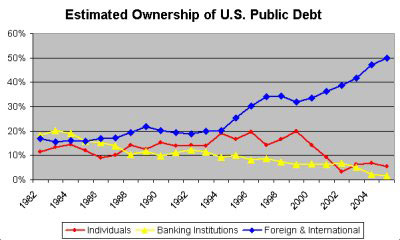
However it also seems to be in everybody’s interest to keep the game going. Asian countries, especially China, want to continue exporting to the United States and keep their currencies from strengthening, preferring to export to Americans and then to loan the money back to them so that they can buy more. Much of the foreign savings go into U.S. government bonds, keeping U.S. interest rates down (currently half of U.S. Treasury bonds are owned by foreigners). The cost of this debt seems manageable, in part because there is slower growth in most of the world’s countries, and so there is plenty of finance capital looking for a safe place to get positive returns. And the low interest rates allow American households to borrow more cheaply, using home equity loans on the seemingly ever-rising value of their homes.

The problem is, as Herbert Stein, Nixon’s economic adviser, famously said, “Things that can’t go on forever, don’t.” Surely a reckoning is coming. U.S. household debt has reached $11.5 billion, an amount equal to an unprecedented 127 percent of annual disposable income. The most recent figures by the Federal Reserve show the cost of debt servicing nearing a record high of 14 percent of disposable income—and interest rates are going up. How long will Asians and others hold U.S. debt when the dollar finally starts to fall and they take losses on their holdings?

Ah, but we have the equally famous retort from Mr. Nixon’s Treasury Secretary, John Connally, “It’s our currency, but it’s your problem.” America’s creditors can’t let the dollar fall too far without serious costs to themselves (their dollar holdings will buy less the lower the exchange value of the dollar). They will be drawn to keep lending. And sure enough, recently the dollar has defied expectations and strengthened, not weakened.

The bubbles and all the debt are serious economic problems and will have political consequences. However, people have been waiting for the dollar to collapse for a while; if it does, will all the unsustainable debt really be unsustainable? Will the dollar fall this year or next? Maybe. But it is possible to argue, and many do, that in an era of financial globalization, in which productivity growth in the United States continues to outpace that in other advanced economies, the United States will continue to be the destination for investment capital. As foreigners diversify out of their own economies, the United States continues to look good. Why shouldn’t foreign investment exceed 100 percent of the U.S. GDP? Why would this be a problem? Why would anyone want their money back if returns are competitive? Why then should the dollar fall? In any case, the big buyers of U.S. treasuries are foreign governments. They are not motivated simply by financial returns. Political pressure can be exerted by Washington should their view of their own self interest change. But why should it change? As for the federal deficit, why shouldn’t the Republicans keep enlarging the national debt? This “starves the beast.” It prevents public spending they don’t want on other grounds.

Is there support for such a Panglossian perspective? The “know-how” that U.S. transnationals export when they invest abroad is a major and uncounted (in the U.S. international financial accounts) export which seems to be responsible for the higher return on foreign investment enjoyed by U.S. investors compared to the return on foreign investment made in the United States. Michael Mandel, Business Week’s economics editor, argues that the United States is really doing far better than the trade and capital flow accounts indicate because of what is going on in the knowledge economy. Intangibles such as research and development (R&D) and the export of knowledge are poorly tracked by the federal government’s outmoded statistical gatherers, who still use industrial era categories. According to Business Week calculations, the ten biggest U.S. companies that report their R&D spending—firms such as ExxonMobil, General Electric, Microsoft, and Intel—have boosted R&D spending by 42 percent from 2000 to 2005, while over these years their capital spending only increased by 2 percent. What looks like less investment is really less investment in plant and equipment but not in intangible investments calculated to improve profits. America’s “knowledge-adjusted” GDP is moving right along, and that is why profits stay high. The decline in nominal investment also reflects the fact that capital goods are becoming less expensive because of productivity growth in the capital goods sector, capital deepening, and the enhanced efficiency due to improved information technology.

Even conceding that investment in the United States may be somewhat higher than official data show, it is not doing much to help the United States become more competitive. The nation’s problems are more severe, upsetting not only to its working people but to some unexpected establishment ideologues who have long celebrated globalization. Thomas Friedman, the New York Times columnist, argues that Bush is not good for America. He writes that the country “faces a huge set of challenges if it is going to retain its competitive edge. As a nation, we have a mounting educational deficit, energy deficit, budget deficit, health care deficit and ambition deficit. The administration is in denial on this, and Congress is off on Mars.” Friedman asks where are the American corporate leaders who would benefit from a serious effort to address these deficits. He can point to G.M.’s interest in health care since its benefit costs have made it noncompetitive and asks if there is any corporation in America that should not be protesting Bush’s cuts in federally sponsored basic research, a key source of innovation. But he also answers with a different voice noting that many key U.S.-based industries get most of their profits and increasingly their best talent from abroad. They are less motivated than in the past to deal with a Congress “catering to people who think ‘intelligent design’ is something done by God and not by Intel.”

There is, however, another way of looking at this. Consider that part of the higher return enjoyed by American investors results from the power of the U.S. imperial state, power that insures against bad treatment. U.S. power sets the rules on debt repayment, intellectual property rights, investor security, market access, and so on, things that no other state can insure for its investors, at least not to the same degree. The difference in the rate of return exists because foreigners are interested in a safe return and the security of their principal, while Americans investing in risky assets have some assurance that the global state economic governance institutions such as the World Bank and the International Monetary Fund, or if needed the U.S. Marines or threats by the State Department, will enforce debt collection so that their debts will be collected. U.S.-based firms charge exorbitantly for intellectual property and collect intellectual property rents, enforced by the World Trade Organization and the U.S. government, but these go to the bottom line of the companies in question. This is surely good news for those who own those U.S. assets abroad.

Sadly, working-class Americans, who are experiencing stagnant or falling real wages, do not share this satisfaction. For them, wages, shrinking benefits, and deteriorating job quality matter more than the external balance position of the United States. In the United States in which they live, income inequality grows dramatically, health care costs rise beyond the means of families, and secure retirement is a vanishing prospect. These are the real deficits for most Americans, serious shortfalls from what they have been led to expect. They are now told that to be competitive, their country must sacrifice its working people’s legitimate hopes.

In the United States where the president talks of creating an ownership society in which workers would “own” their own health care and retirement through privatized individual accounts, defined-benefit pensions, which guarantee a fixed amount of money after retirement, are replaced by defined-contribution plans, in which benefits depend upon what a worker can put in and the uncertainty of the equity market. The basic idea of social insurance, where all contribute and receive based on need, is canceled as those who can afford more not only get more but receive favored tax treatment for each dollar they set aside for their own welfare.

As part of the program, there are reductions in income tax (paid disproportionately by the rich), in taxation of corporations, and in capital gains and inheritance taxation that overwhelmingly benefit the rich. Government deficits created by these regressive tax cuts are partially offset by increases in payroll taxes, and proposals pour forth in support of consumption and flat-tax ideas—all new tax burdens for workers, with capital exempt.

Instead of unemployment benefits, there are to be personal reemployment and training accounts of limited size. Instead of well-funded public education, there are unfunded mandated testing and school vouchers. Consumers hurt by defective products and such are limited in their right to sue, and people who are bankrupted by personal tragedy can no longer seek bankruptcy relief as they have in the past. Government regulations to protect consumers are seen as inefficient because they increase the costs of doing business and are repealed or go unenforced, or are enforced by former industry partisans. Devolution of responsibilities from federal to state government undermines promised benefit levels, since states cannot afford such burdens and federal help is reduced.

This is the Ownership Society as envisioned by George W. Bush and those around him. It is a package of policies attacking the idea of citizenship rights and follows Margaret Thatcher’s principle that there is no such thing as society, only individuals. It stands in contrast to the principle unifying working-class movements everywhere—and at all times—solidarity. The deficits the Bush administration have created are undermining American society as we have known it. They are, however, in the narrow interests of the capitalist class.

While experts debate how long things can go on without a serious crisis, there is a structural issue of great importance to consider, namely the lack of significant domestic investment by U.S.-based transnationals and the continued expansion of their investment elsewhere. While U.S.-based corporations are earning record profits, they are investing little in the United States. For 2005, the Standard and Poor’s 500 U.S. corporations set new records, spending half a trillion dollars both to buy back their own stock and to pay dividends. Even the fund managers who profit in the short run worry that companies are underinvesting in their businesses. While profits were in many cases setting records, firms were not increasing investment; instead they were retrenching. Their profits were in fact coming from cost-cutting. This is not to say consumption was not rising. It did increase. But the majority of the increased spending was funded through debt creation, most of this due to the wealth effect of the increased value of real estate. Between 2000 and 2005, U.S. house prices increased by more than 60 percent. The market value of real estate in 2006 is about 200 percent of personal disposable income, and mortgage related assets are equal to over 60 percent of bank lending compared to 25 percent in 1970. As one investment analyst has written, “George W. Bush was re-elected president during 2004 because he presided over more housing inflation than any other American president.” That, and by scaring voters. The single-minded war on terrorism obscures stagnant and falling living standards for most of the U.S. working class.

Investment in residential construction is not the sort of investment that provides a surplus to repay foreign debt. The sectors which are growing in the United States, like health care, produce for the most part nontraded goods and services. It is only the growth of financial services, some specialized high-tech exports, and foreign investment that are showing high returns, and the firms controlling these are moving more activity offshore, following manufacturing’s lead and leaving the domestic service economy to create jobs—many low paying, temporary, and without benefits.

U.S. foreign borrowing is not significantly being used for investment to increase the productive capacity necessary to pay back the debt but for consumption, tax cuts, and military spending. From a ruling-class perspective (or at least some fraction of it), it could be argued, military spending is investment in the capacity of the U.S. state to intimidate others into accepting U.S. rules and to obtain control over valuable resources such as oil. From such a perspective, this is money well spent. However, the cost of imperialist adventure is going up and is not matched by success, so the cost/benefit ratio as seen by most ordinary Americans is not looking very good. The Persian Gulf War under the first Bush cost about $61 billion. Eighty percent of the total was paid for by American allies—Saudi Arabia, Kuwait, the United Arab Emirates, Germany, Japan, and South Korea, leaving the dollar cost of that war at only $7 billion for the United States (Japan alone contributed $13 billion). The Iraq invasion and occupation is a very different story. The United States is paying in lives and treasure, and it will continue to pay. The inflationary impact of such spending is hidden by low interest costs and the willingness of lenders to finance American profligacy.

What about the countries that are lending the United States all this money? Much of the so-called savings glut is coming from Asia. It is not the result of increased saving by households or private corporations. Rather it is fed by public sector saving as governments have cut back and increased their surpluses. Since the 1997 Asian financial crisis, which the Asian governments understand to have been a liquidity crisis, they have taken precautionary steps to dramatically increase their reserves to prevent a replay. Between 1996 and 2003, developing countries as a whole moved from a collective deficit of $88 billion to a surplus of $205 billion, a net change of $293 billion, a vast increase in global savings. The Federal Reserve estimates that this surplus increased by $60 billion in 2004. Figures for 2005 will show further increase. It is also the case that since the crisis, investment rates have fallen in the region (except for China) by more than 10 percent from the mid-1990s peak, as excess capacity is still being worked off and adjusted to the China impact. Because all of this saving is not being absorbed in productive investment, interest rates have fallen. Low interest rates have fueled the real estate bubble in the United States and some other places and allowed the cashing-out of the home equity loans that have fueled U.S. consumer spending.

Government-generated liquidity is also the engine of the other great motor of the contemporary global economy, China. China’s incredible investment rate, about 45 percent of its GDP, is also being driven by liquidity and not necessarily by expected profitability, raising the potential that China is growing too fast for its own good. State-owned banks are lending money to state-owned companies. In the case of enterprises owned by provincial authorities, borrowing and investment often seem to be uncorrelated with profitability, but rather are politically driven. Saving rates in China remain high in part because of an aging population worried about life in a free-market economy in which the provision of pensions, housing, education, and health care are not provided as a right by the state. At the same time, the significance of the U.S. current account deficit with China is complicated by a number of factors. First, most of China’s exports are controlled by foreign companies. These companies receive the profit when, say, a Barbie doll made for thirty-five cents in China sells for twenty dollars in a rich country’s market. Second, many of the products exported from China are not made there but assembled there from high-value components produced elsewhere. China’s value added is a fraction of the value of exports.

In 2005, China was the dominant Asian exporter, while exports from Asia as a whole were 36 percent of all world exports. In 1990, when Japan was the dominant exporter and we worried about Korea, Taiwan, Singapore, and Hong Kong, total exports from Asia were 38 percent of world exports. Much of what comes from China used to come from someplace else in Asia. Today Sony, Toshiba, and Panasonic, among others, send their products to the United States from China. Korea’s Samsung has twenty-three factories in China employing 50,000 workers. Taiwan may still control the market for computer components, but they are assembled in China by low-wage workers. Locals get only a small part of the profits generated. So while it is true that the U.S. deficit with China rose by 25 percent (to over $200 billion in 2005, and this is the largest debt the United States has ever run with any country), it is also the case that China’s deficit with the rest of Asia was more than two-thirds the size of its surplus with the United States. All together, the U.S. deficit with Asia has changed very little in recent years. It is the total value of oil and other energy sources that has been rising dramatically, thanks to the demand of a United States which refuses to conserve energy, causing it to run an increasingly large deficit when oil prices rise.

Importantly, on a global scale, saving and investment rates have both gone down, trends mainly reflecting developments in the industrial countries where both saving and investment have been trending downward since the 1970s even as saving has been increasing in the oil-producing countries and in Asia. The industrial countries still account for 70 percent of world saving, but this is down from 85 percent in 1970. Together, global savings and investment are near historic lows, having fallen markedly since the late 1990s. The even more telling figure is for the rate of growth of the global economy, which has been falling since the 1960s, when it was 5.4 percent to 4.1 percent in the 1970s, to 3.0 percent in the 1980s, to 2.3 percent in the 1990s. While mainstream economists dismiss any idea of a race to the bottom, there is an unquestionable slowing of growth and an emergent underconsumptionist, or rather overaccumulationist, trend. While global growth has slowed, the reach of transnational capital has dramatically increased, and its power to seek out lower costs and play workers in one place against workers elsewhere has grown. What we are seeing is a process of redistributional growth, in which over the ups and downs of the business cycle, capital’s share of the social product is increasing and labor’s share is diminishing.

There is a clear thread that connects domestic developments in the U.S. income distribution, debt-funded growth, the increased dominance of the rentier capitalists who profit from these developments, and global ambitions and the projection of imperial dominance. A century ago John A. Hobson argued that as the power of rentiers grows and taxation becomes more dramatically regressive, a hegemonic power (then Great Britain) is tempted to engage in imperialism. Hobson urged higher taxation of incomes generated as a result of financial speculation and government favoritism to produce a more equal distribution of income and higher working-class and middle-income spending, which would encourage domestic investment and make imperialism less attractive. He wrote,
The issue in a word, is between external expansion of markets and of territory on the one hand, and internal social and industrial reforms upon the other; between a militant imperialism animated by the lust for quantitative growth as a means by which the governing and possessing classes may retain their monopoly of political power and industrial supremacy, and a peaceful democracy engaged upon the development of its national resources in order to secure for all members the conditions of improved comfort, security, and leisure essential for a worthy national life. (John A. Hobson, “Free Trade and Foreign Policy,” Contemporary Review 64 [1898]: 179, quoted in Leonard Seabrooke, “The Economic Taproot of US Imperialism: The Bush Rentier Shift,” International Politics 41, no. 3 (September 2004): 293–318.

Today the “rentier shift” produces the very conditions Hobson warned of in the context of Great Britain a century ago. The growth of the rentier economy and the drive for external expansion long evident in U.S. history (and surely under both Clinton and Bush, albeit with a different policy mix) has been fed by an investor politics that has favored the very rich disproportionately in both taxation and government spending priorities. The dramatic increases in the upward redistribution of income have contributed to driving the investor class to look for opportunities abroad as the slower growth, and indeed saturation, of domestic markets pushes them to do. And this is taking place even as their increased class dominance—with trade unions and working-class power weakening, and real wages stagnating—allows them to push for a greater degree of regressive taxation and less progressive redistributive state spending.

Along Hobsonian lines, Arjay Kapur, a Citigroup strategist, argues that the rich are responsible for the low saving rate in Anglo-Saxon economies, which he describes as “plutonomies”—economies driven primarily by the wealthy as compared to the more egalitarian Japanese and European economies. In the plutonomies, above all the United States, it makes little sense to speak of the average consumer, since the top one percent of all households has 20 percent of the income, about the same as the bottom 60 percent.

Spending in the United States is driven by the asset inflation of the equity and real estate holdings of the top 10 percent of the income distribution. The wealth effect of such holdings allows debt- financed spending and results in the negative saving rate. Kapur finds that throughout our history there has been a strong negative correlation between the share of U.S. income going to the top 1 percent and the overall saving rate—the higher the share, the lower the saving rate. Economies with low saving rates tend to show current account deficits and the need for foreign borrowing.

To this analysis one might add that the power of the United States to command foreign credit depends in some measure on the power of the U.S. state, the continued use of the dollar as the reserve currency, and other factors which ultimately rest on U.S. imperial power. This relation is two-way. Harvard’s Linda Bilmes and Columbia’s Joseph Stiglitz estimate that the eventual cost of the war in Iraq will be more than a trillion dollars and possibly closer to two trillion dollars. So far the Bush administration has borrowed the money and underestimated the cost, but its policies raise the specter of imperial overstretch and the need for further coercion to keep the American economy afloat.

Past empires have followed the path that the United States seems to be going down, a movement from manufacturing production as the core activity to financialization and rentier income, and then finally bankruptcy from a loss of competitiveness and the cost of maintaining empire. For the elite there seems no better alternative, even if this is finally a negative-sum result. Any more positive strategy from the perspective of a democratic majority would require policies that would weaken the power of the ruling elite. It appears to this elite that it is better to continue to get rich and maintain power through the period of national decline. To the extent that this class can obtain rents from the familiar sources of state handouts, corrupt dealings, and tax policies, it stands to gain.

In conclusion, the concern over debt levels and bubbles is certainly appropriate. What is essentially a regional and sectoral disproportionality crisis leading to imbalance in capital flows and the high debt position of the United States is deserving of the attention it is receiving from all points on the ideological compass. What must be central to such discussions, however, is the class dimension of the accompanying redistribution of wealth and power and the resultant impact on members of the world’s working classes. Disproportionalities are more than matters of technical economics. They are manifestations of class struggle. Understood in this way, analysis enables more clear-sighted mobilization addressed at real enemies and demands for real solutions. Imperialist adventurism today serves the U.S. ruling class. It comes at the expense of working people everywhere.

May 12, 2006

Gold Bugs


By Peter McKay

The Wall Street Journal

Thursday, May 11, 2006

Investing pros have begun pondering the possibility that gold will

hit a record over $800 a troy ounce soon. This means that the gold

bugs -- that patchwork of sometimes offbeat investors who love the

shiny stuff -- are happier, and louder, than ever.

Gold futures for May delivery have risen this week 3.2%, or $21.50,

to a 25-year high of $703.70 per troy ounce. In the past two years,

prices have soared 86%.

"We all said what was going to happen and why," says Bill Murphy, an

ex-professional football player and trader who heads up a group that

goes by the name Gold Anti-Trust Action Committee, or GATA.

There are lots of reasons behind the move: For one, the dollar has

weakened, and seems headed lower. When people lose confidence in

paper currency some turn to gold, which is still seen in some parts

of the world as an alternative store of value, despite many years in

disfavor. This reputation as a store of financial value means it is

also seen as a hedge against inflation, which shows signs of picking

up, and against political turmoil, like say, turmoil in Venezuela,

Iran and Iraq.

For some gold bugs, though, it's rarely that simple. Back in 1999,

when gold was at multiyear lows around $250, GATA argued the metal's

price was being artificially suppressed by a cartel of large private

banks selling borrowed gold, much of it on loan from powerful

central banks. The latest stage of the rally, Mr. Murphy says, is

because Russia has become a heavy buyer, helping to squeeze the

alleged cartel.

"They're a little conspiratorial, for me even," says money manager

Peter Schiff, an outspoken gold bug himself. "I don't know if there

was any real orchestrated event."

Whatever the case, the gold bugs aren't alone anymore. The

investment audience for the precious metal is broadening as hedge

funds and others seek alternatives to stocks and bonds. Because the

gold market is relatively small, in terms of physical metal

available and the number of investors who have traditionally

participated, even a small increase in mass appetite for the metal

can result in more price increases.

Pick your reason. Gold seems headed higher still.

May 11, 2006

Copper Commision Report bullish

Copper nominal price reached on Friday a new historical high of 354,256 ¢/lb., growing by 8% with
respect to last Friday. Stocks registered with metal exchanges closed at 159,630 MT, falling by
2.6% (-4.3 thousand MT), showing current market shortage.

Copper price increase was due to the influence of different factors such as the present stocks
decreasing trend, optimistic reports regarding copper market future issued by some important
market agents such as BHP Billiton, and the US dollar weakness encouraging investors’ entrance
to the market. All occurred during a week in which holidays in China and Japan have moderated
market activity.

News of this week related to supply show the appointment of an arbitrator in the negotiations
between workers and Lomas Bayas (property of Falconbridge), which if no agreement is reached, it
could mean that strike would come into effect next Monday. On the other hand, paralyzation at La
Caridad mine in Mexico –it started last 24 March– continues. Besides, comments of BHP-Billiton’s
marketing director regarding prices will remain high until stocks increase from their current low
levels, strongly impacted as the current market bullish view was reaffirmed by one of the world’s
main copper producers.

Regarding demand information, different economic indicators show good future outlooks. In the US,
the leader indicators of industrial activity, ISM, and the factory orders surpassed market
expectations. On the other hand, the European leading industrial indicator grew with respect to last
month. There exists an historical positive correlation between both indexes and copper demand,
thus allowing anticipating that it would continue as dynamic as scheduled.

Demand dynamism, within a low copper availability context, explains part of spot premiums growth
in Europe, currently averaging US$ 165 per MT, with respect to US$ 135 per MT in April. It must be
considered that premiums correspond to the paid value on copper price and reflect physical market
trends. Besides, concentrates market information is confirming the expected lower availability. The
Germany refinery Norddeutsche Affinerie informed that raw material shortage would last until next
year, thus allowing anticipating strong mid-year negotiations between mining companies and
smelters in defining supply treatment charges. These have already established a strong downtrend
placed in values near 100/10 (and even lower) from 140/14 previously registered in the spot market.

The American currency fell by 0.5% until Thursday with respect to the previous Friday, and
surpassing 1.27 US$/€, at similar values as those of May 2005. A weak dollar has a positive effect
on commodities, which is reflected in the LME metals price index, which as of yesterday grew by
6.9% with respect to the previous Friday, due to strong rises of zinc and copper. Precious metals
were also influenced by the US dollar weakness, closing gold today at 682 US$/ounce (London
Initial) and silver at 14.070 US$/ounce (London Spot), growing by 6.9% and 12.1%, respectively.

Copper price, whose bullish trend has not changed, will continue to be determined by the evolution of the
pending labor issues (Grupo México, Lomas Bayas), as well as by any other new information mainly related
to supply. Besides, the US dollar evolution could continue influencing on commodities’ price.

May 10, 2006

Someone big wants in to the Gold Market

Gold has surged to $700 an ounce for the first time in 26 years after Chinese economists suggested the country should quadruple its bullion reserves to protect against a falling dollar.Speculators have been alert to any sign that Beijing may be planning to switch a portion of its massive $875bn reserves into gold, a move that would electrify the market.

They seized on comments yesterday by Liu Shanen, an official at the Beijing Gold Economy Development Research Centre, who said China should raise the portion of gold in its reserves from 1.3 percent today to between 3 and 5 percent. Such a move would entail the purchase of 1,900 tonnes of gold, equivalent to gobbling up nine months of global mine production.

Washington's cold response to Iran's move to defuse nuclear tension also helped fuel yesterday's rally. "No one is buying Iran's overtures," said Frank McGhee, a metals trader at Integrated Brokerage Services. "This is a purely geo-political move for gold. We've been here before. The difference is that this time, there are nukes involved."

June gold futures jumped $20.10 an ounce in New York, briefly touching the $700 line before falling back slightly.Tan Yaling, an economist at the Bank of China, backed the call for higher gold reserves to "help the government prevent risks and handle emergencies in case of future possible turbulence in the

international political and economic situation".John Reade, a UBS analyst, said neither economist had any official role but hints were enough to drive prices in the current climate. "This is an investor frenzy, and China has become the
biggest rumour in the gold world right now," he said.Mr Reade said gold had changed stride since the middle of last year, the key moment when it broke out against all major currencies and began to attract investment from the big money brigade.
"Speculative and investment interest has replaced jewellery demand. The last time that happened was in 1979 to 1980," he said.He said it was likely that Middle Eastern investors were switching
petrodollars into gold after burning their fingers in local stock markets.

Ross Norman, director of the BullionDesk.com, said China may already be a silent buyer on the open market.Central banks are supposed to record their gold purchases with the IMF promptly, but they have been known to move stealthily for months before declaring.

"This market has been bouncing back so quickly after each bout of profit-taking that it looks as if somebody big is trying to get in. It's too darn hot for my liking," Norman said.Mr Norman said there was a fair chance that gold mining equities would start to play "catch-up."

Special report from The Privateer - A newsletter I recommend.

As you will know by now, spot future Gold rose $US 21.60 to hit $US 701.50 at the close on Tuesday, May 9. This event was reported on CNNMoney.com under the headline: $700 Gold: Want in? Think Twice. On the surface, this is the normal type of stuff that the US mainstream financial media comes up with. They have to report it because it's news, but they structure the story in a way that they hope will dissuade most people from diving into the Gold market.

As we said, "normal", at least on the surface. But check out this story from exactly the same source, posted just under a month ago on April 11: $600 Gold: Want in? Think Twice. We strongly suggest that you print both these stories out and compare them. You will find that practically nothing but the numbers ($600 vs $700 as a Gold price) has changed. Clearly, the author of the two reports simply used the $600 Gold report as "boiler plate", substituted $700 for $600 in the $700 Gold report, and left the rest completely unchanged.

Please note that our Gold This Week commentary for April 14 - "Gold's Great - But Not For "Individuals" was based on this $600 Gold report from CNNMoney. What we said in that report goes double or triple for this new report, published less than a month later and with Gold $US 100 or 16.7% higher. This is very sloppy work indeed from the mainstream media. It will be interesting to see if they do it again at $US 800 Gold.

May 08, 2006

Mirages of Western Gold Bugs:


I think that this piece reflects my position to a significant degree... 

The Islamic Gold Dinar, the Iranian Oil Bourse and the Gold Standard

Dr. Eckart Woertz
Dubai, UAE
May 8, 3006

For many Western gold bugs, the precious metal is not an investment but a religion. Not surprisingly, the styles of their writings often resemble apocalyptic judgment sermons rather than sober investment analysis. The ideological importance they attribute to gold is rivaled only by the one the Communist Manifesto used to have for a different tribe. If gold is salvation, there needs to be a devil taking the other side. For die-hard gold bugs, this is the paper dollar and its various sinister manifestations reaching from big government to Wall Street, and the freemasons. Everything that is supposedly against such evil mongers has to be blown out of proportion and the farther away the country of origin the more outlandish the exaggerations become. Two perfect examples are the Islamic gold dinar and the Iranian euro-denominated oil bourse. Living in the Middle East, I have repeatedly been astonished by the huge gap that exists between web-based gold bug perceptions on the one hand and actual reality on the other hand.

The Islamic gold dinar was supposed to be used to settle bilateral trade between Muslim countries. By randomly surfing the Internet during the height of Islamic Dinar advertisements in 2002 and 2003, one could have gained the impression that the Islamic world was on the verge of skipping any payments in dollars or other paper money and switching to a gold standard like that of the good old 19th century. Unfortunately, off the web, in Middle Eastern reality the gold dinar was a non-issue. Yes, the initiator, Malaysia, had talks with Iran, Saudi-Arabia, and some other countries, but that was pretty much it. Even specialized central bankers in the region who were supposed to make the gold dinar a reality didn't have a clue about the idea. Thus, nothing has happened, Iran has not engaged in a settlement of bilateral trade with Malaysia using gold dinars, and the Gulf countries, which offered some polite interest, have quietly withdrawn, and are more inclined to discuss diversification into the Euro. A possible explanation for this failure is the trade surplus of Malaysia, which would have sucked the tiny gold reserves of the Gulf countries dry in no time, as an adjustment mechanism between the gold dinar as a trade currency and the money supply of the participating countries was not intended. Even more importantly, this hints to the simple fact that Islamic governments also love some expansionary monetary policies every once in a while. With the retirement of the main gold dinar proponent, former Malaysian Prime Minister Mahathir, the insight has dawned on many that the idea is dead. Even hard core gold bugs who are reporting from the "occupied South" or roaming the forests of Montana with their militia buddies should have grasped this in the meantime. But that's no problem as there is a new kid on the block: the planned Iranian oil bourse, which will offer euro-dominated oil contracts and will thus bring about the fall of the dollar.

The oil bourse as well has not really been a topic in Iranian newspapers. The Iranians do not seem to attribute the historical 'dollar-killer role' to the idea like gold bugs do. On May 6, Mohammad Javad Asemipour, advisor to Iran's oil minister and head of the bourse project, dismissed such notions as "propaganda." The project was not intended to rival marketplaces in New York, London, and Dubai, he said. Its goal was simply to increase liquidity in local energy markets, and in the beginning there was not to be any trading in crude oil, only in petrochemical products. The real bombshell for gold bugs, however, was that he said that pricing in euros was not intended! Anyway, after some postponements, the Iranian oil bourse is supposed to be set up this month on Kish, a small island free trade zone in the Arabian Gulf. The island is sleepy, and in the middle of nowhere. Along an empty road outside the city center there is a concrete desert of run-down hotels where workers from Dubai dwell. When their UAE visas are up for renewal, their employers send them to Kish for a visa roundtrip. But sometimes the paperwork does not arrive for weeks due to red tape and deliberate delays and they get stuck - cost-efficiently 'stored' without pay.

If you told one of these desperate souls that the lost island they are on will be the center stage of the coming dollar collapse, they would probably think you are crazy. It is not really a place where a highly paid oil trader from London, New York, or Singapore would like to relocate. It is as far from a functioning financial infrastructure as Pyongyang or the Antarctic. Back office facilities, settlement procedures, trading infrastructures, legal frameworks, debt markets, you name it. Need some credit to finance a major transaction? No problem, fill out a form and send it to one of the government-owned banks in Teheran, and in the meantime relax and enjoy the sunny climate. Pricing oil in euros would certainly be a nightmare for the dollar, but it will not happen to any meaningful extent because of the Iranian oil bourse. Like the Islamic gold dinar, it is a mirage of Western gold bugs - they see it from far away, on the web, but if they took the pain to apply for a passport and travel a bit, they would see it disappear.

I guess the political correctness squads of the gold bug community are already on their way to flood my mailbox. But wait a minute - I like gold, I am heavily invested because I think it will go much further, especially in dollar terms. Yes, the US twin deficit has gone out of control, and yes, Helicopter Ben is likely to choose inflation over deflation as a 'solution' to the debt problem. But at the same time, this debt is the only thing that keeps the world economy running, as every gold bug accurately observes. The US housing and consumer markets that goes without saying, but the Japanese love it as well, as the yen carry trade has enabled them to stabilize their shaky financial system with a zero interest rate policy and without inflation. China and Southeast Asia still have no alternatives developed for their export-oriented industrialization, and the Europeans have not exactly invented balanced budgets - they are content to sail in the geopolitical and economic wake of the US as well.

Of course, there will be continued diversification out of the dollar via the currency markets, and the euro and gold are obvious candidates. Norwegian plans to set up a euro-denominated oil bourse are much more likely to be a success than Iranian ones, and bilateral trade agreements like the $70 billion gas deal between China and Iran are already taking away liquidity from dollar-denominated open markets. Such deals might even use the euro as a pricing unit some day. But that will not change the nature of the game; the virtual reality of financial growth has become paramount. It seems like capitalism cannot expand in the real world anymore because geographically, it colonized all the non-commodified virgin lands a long time ago, and the inward expansion of new products and new markets got stuck in a stillborn microelectronic Kondratieff cycle. New products and markets still emerge, but do not absorb enough labor anymore because of the huge rationalization potentials the microelectronic revolution has set free. That leaves as the last frontier of growth the deceivingly limitless realm of numbers and financial engineering. If you think that's bad, be sure the deflationary shock of a gold standard would be worse.

What leads us to the ultimate mirage of Western gold bugs: the reintroduction of the gold standard. This is neither feasible nor desirable. Forget that the much-hailed age of the gold standard was not as cosy and peaceful as gold bugs perceive. After all, child labor was rampant and Western governments divided their time between policing the poor at home and killing and colonizing natives on foreign shores. Once they had consolidated their nation-states, imperialist competition between them got really ugly and finally ushered in World War I. Hardly a proof that a simple metal makes better societies; but there was low inflation, and gold bugs celebrate the period as 'freedom.' However, the main flaw in the gold bugs' view of history is that the homo oeconomicus who has expressed all his needs, relationships, and wishes in monetary quanta from time immemorial is a fiction. So is the conviction that in capitalism money is used to fulfill needs, instead of being an end in itself. These are axiomatic beliefs invented by neoclassical economists, Austrians, and other flat earthers of economic history.

Capitalist societies in the 19th century were still in a nascent stadium of development, and hardly comparable to the completely commodified ones we face nowadays. They comprised various forms of non-capitalist production (e.g. household work, agriculture), and the cold logic of accumulating abstract wealth in the "disembedded" spheres of market and state (Karl Polyani) was not yet generalized. It is hardly conceivable that capitalist societies could fit again into the tight golden corset in which they once flourished for a while when they were little babies. Thus, the gold bug's state of mind - affirming capitalism by evoking a harmonious picture of peaceful market communities and the whole 'honest money for honest work' charade - alludes to a past that never was and a future that will never be. The only thing that saved capitalism after 1929 was state intervention and monetary expansion, and the only thing that saved it after 1971 was even more monetary expansion and the advent of a brave new world of financial engineering. So let's hope that the music will continue to play for a while, because it will be difficult to grab a chair once it stops. And be careful what you wish for - or which gold bug is ready to tell the last GM worker to go home without knowing how to feed his family?

Best regards from Dubai, Eckart

-Dr. Eckart Woertz
Program Manager Economics
Gulf Research Center
P.O.Box 80758
187 Oud Metha Tower, 11th Floor
303 Sheikh Rashid Road
Dubai, UAE

Faber -Dollar is doomed!

Gold price to kick into full gear: Faber

Date : 07/05/2006

Reporter: Alan Kohler

ALAN KOHLER: Well, the death of the Greenback, gold at $US6,000 an ounce with commodity and energy prices rising vertically, spurred on by growing international tensions and war - no, that's not the background to the latest sci-fi pot boiler, but the tentative vision of one of the world's most respected contrarian economic forecasters, Marc Faber. Dr Faber must be taken seriously though because of his record in predicting, among other things, the global stock market crash of 87, Japan's collapse in 1990 and the Asian meltdown of 1997 - forecasts that earned him the moniker Dr Doom. He's also the editor and publisher of the influential The Gloom, Boom and Doom Report. And, as you'll hear, he has some very interesting views on the relative merits of the Australian and US central banks. I spoke to Marc Faber from New York this week.

Marc Faber, just to put this week's interest rate increase in Australia into a global perspective, do you think the developed world in general is in a process of increasing interest rates and reducing liquidity that has a way to run yet?

MARC FABER, 'THE GLOOM, BOOM AND DOOM REPORT': Yes, I think so because we have a global boom and interest rate increases have been very slow. In other words, in the US, we went from 1 per cent on the Fed fund rate in June 2004 to 4.75 per cent, but I think that inflation is higher than 4.75 per cent. And if you look at long growth in the US and credit market growth, then we haven't had tight money yet because if money was tight, then asset markets wouldn't rally as they do at the present time.

ALAN KOHLER: There is a lot of debate in the financial markets about whether the US will have a pause in its interest rate tightening cycle. What do you think?

MARC FABER: Well, I basically think that Mr Bernanke is a money printer and it's interesting to see that since he was appointed Fed chairman, the price of gold has risen by 42 per cent so the market is not very happy with his bias towards money printing.

ALAN KOHLER: Do you think that Mr Bernanke is losing control of the situation, in fact? I mean, I notice the markets are testing him now.

MARC FABER: I think that on his recent comments that the Fed might pause, immediately the US dollar became very weak, the bond market sold off and gold prices shot up another $20, $30, so that is a lesson for him that the market begins to see through his inflationary monetary policies.

ALAN KOHLER: What do you think of the Australian central bank and its decision this week to increase interest rates?

MARC FABER: I think actually that the Australian central bank is probably relatively better than others in the sense that they have further tightened monetary policies and so we have in Australia an interesting situation. The economy is kind of weakening, but there are some inflationary pressures and the Australian Reserve Bank has increased interest rates so I find it is actually quite courageous.

ALAN KOHLER: What do you think it means for the Australian dollar?

MARC FABER: Actually what has happened, the Australian dollar along with the New Zealand dollar was weakening recently but in the last, say, two weeks the Australian dollar has again strengthened from 70 cents to 76 cents, so I would say the Australian dollar is supported by relatively high interest rates.

ALAN KOHLER: What do you think about the length of the current commodities boom? You've written recently about firstly how the long wave of commodities could last for another 15 to 20 years and you've also talked about the impact of India on commodities, so where do you see prices of commodities going from here?

MARC FABER: Basically we had a bear market in commodities between 1980 and 2001, or 1998 and 2001, so we had more than 20 years bear market in commodities. By the late 1990s in real terms, in other words inflation-adjusted, commodity prices were at the lowest level in the history of capitalism in the last 200 years and now they have risen substantially - the price of copper from around 60 cents to over $3 a pound, the price of gold has more than doubled. But in real terms, commodities are still relatively low compared to equities and therefore, also given the length of the cycle - the cycle for commodities lasts usually 45 to 60 years peak to peak or trough to trough - in other words the upward wave in commodities lasts around 22 to 30 years and we are now in year 2006. The bull market started in 2001 so we are five years into the bull market. I do concede that the markets are overbought and there is a lot of speculation and I expect a correction but I think longer term from here onwards commodities will outperform the Dow Jones and financial assets.

ALAN KOHLER: You've been reported as predicting that the price of gold will rise to $US6,000 per ounce. Is that correct - is that what you said?

MARC FABER: What I said is that if Mr Bernanke prints money, it is entirely conceivable that the Dow Jones goes to 33,000 or 40,000 or 100,000 or 1 million. All I am saying is if the Dow Jones here goes up three times because of money printing by Mr Bernanke and we have examples in financial history where a central bank printed money and everything went up, but in this instance I think that gold would significantly outperform the Dow Jones. So if someone says to me the Dow will go to 33,000, I say yes, it's possible but it will decline against the price of gold which will go up to $US5,000, $US6,000 an ounce.

ALAN KOHLER: Did you notice that Steven Roach, the chief economist of Morgan Stanley, who has been a bear for a very long time, seems to have changed his tune now, saying he's feeling better about the world than for a long time. Do you think that the fact that Steve Roach has kind of thrown in the towel is a sell signal or do you think he's onto something?

MARC FABER: Well, Steve is a good friend of mine and he gave already a sell signal two years ago. He suddenly turned bullish about bonds and since then the bond market has been weak. And I agree with him that we are in a global boom but it doesn't change the fact that it is an imbalanced boom and it's driven largely by credit creation in the US, leading to overconsumption, leading to a growing trade deficit, current account deficit, the accumulation of reserves in Asia and a global boom. But it is nevertheless an imbalanced boom and one day there will be a problem, certainly with the US dollar. The US dollar is a doomed currency. Doomed? Doomed. Will be worthless. Actually each one of your listeners should buy one US Treasury bond and frame it - put it on the wall so they can show their grandchildren how the US dollar and how US dollar bonds became worthless as a result of monetary inflation.

ALAN KOHLER: You made at least three great calls - you warned of the 87 crash just before it happened, you warned investors to get out of Japan in 1990 and out of Asia in general in 1997. So what specifically is your call right now?

MARC FABER: I think we are in a bear market for financial assets. There's a bear market where the Dow Jones, say, would go from here - 11,000 to 33,000. It would go up in dollar terms but the dollar would collapse against, say gold or foreign currencies. That's what I think will happen with Mr Bernanke at the Fed because he has written papers and he has pronounced speeches in which he clearly says that the danger for the economy would be to have not deflation in the price of a fax machine or PC, but deflation in asset prices. And so I believe that he is a money printer. If I had been a university professor, I would not have let him pass his exams to become an economist. I would have said, "Learn an apprenticeship as a money printer."

ALAN KOHLER: (Laughs) So, a big mistake putting him in charge of the Fed then?

MARC FABER: I think it's very dangerous, very dangerous.

ALAN KOHLER: You've talked in the past about the links between the commodity price cycles and political tensions in the world and you've pointed out that when the Soviet Union collapsed, commodity prices were weak and you've said that rising commodity prices leads to the conditions for war. Now that we're in a commodities boom - which you now say is going to go for a long time - do you think that we're in for a period of rising political tension as well?

MARC FABER: Basically the way we economists have business cycles theories, the historians have war cycles theories and I don't want to go into all of them, but when commodity prices decline, countries are not concerned about getting supplies of vital commodities, whereas when commodity prices go up, it's a symptom of shortages. America needs oil for consumption and China and increasingly India need oil for their economic growth. If you are growing your industries at a production of 15 per cent per annum, as China, you need increasing quantities of oil and China was self-sufficient until 1994 and today they are the largest consumer of oil and import most of it from the Middle East. So the tensions of course arise and I can see that some people have become very powerful whereas the balance of power in the 80s and 90s shifted to the industrialised countries of the West that consume a lot of oil, now the balance of power has shifted to people like Evo Morales, Hugo Chavez in Venezuela, Mr Putin - Mr Putin is the most powerful man in the world, it's not Mr Bush because Mr Putin controls a production of oil of 10 million barrels, plus he controls all the pipelines going to Europe. And it has also shifted to Mr Ahmadinejad. Mr Ahmadinejad of Iran would be very quiet, as well as Mr Chavez, if oil prices were at $12. But at $70 they have a lot of leverage and so the tensions have also increased. It doesn't mean that it comes to war but the conditions for war have improved and I think that eventually this commodity cycle will last so long until there is a major war and during war times, the best hedge is to be low in commodities, then commodities really go up vertically.

ALAN KOHLER: Bit of a grim way to make money, I suppose?

MARC FABER: Hedge funds make money anyway. It doesn't - morals are not the most important issue.

ALAN KOHLER: Well, on that note we'll have to leave it there. Thanks very much, Marc Faber.

MARC FABER: It is my pleasure

Watch Faber